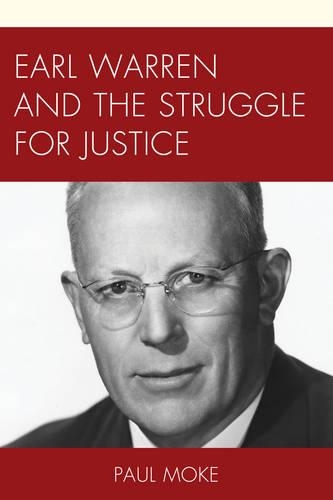
Книга Earl Warren and the Struggle for Justice
Earl Warren and the Struggle for Justice explores the remarkable life of one of the leading public figures and jurists of twentieth century America. Based on newly available source materials, it traces Warren’s progressive vision of government from its origins in the fight against urban corruption in Oakland, California during the 1930s to its culmination in the effort to professionalize public school administration, law enforcement, and the management of the electoral process under the auspices of the U.S. Constitution. Although Warren’s major social justice decisions strengthened democracy at a crucial juncture in American and world history, in times of crisis his excessive deference to national security officials sometimes jeopardized other core human rights, as shown in his approaches to the Japanese internment and the investigation into the assassination of President John Kennedy. The book offers accessible and fresh insights into the dynamics of the Supreme Court and the accomplishments of Earl Warren, the man, jurist, and political leader.
"The book presents additional insight into the work of the Warren Commission." - Wilmington News-Journal
"[An] insightful judicial biography. . . . Moke’s biography provides an evenhanded appraisal of the Chief Justice’s shortcomings and misjudgments not only while on the bench but in his public service prior to and beyond the high court. An equally important contribution of Moke’s book, possibly of greater value in this reviewer’s estimation, reminds us how the Supreme Court’s approach to the law, often guided by its Chief Justice, matters. . . Hopefully, [the book] will. . . find a home in college and university holdings as well as public libraries; it deserves to be read." - American Review of Politics
"Moke argues that Earl Warren was one of the central political figures of his time. Warren, who had been attorney general and governor of California, was chief justice from 1953 to 1969; he participated in the civil rights revolution that benefited African Americans, the cases that were meant to enforce the rights of criminally accused persons, and the court-ordered reapportionments of legislatures based on the one-person, one-vote principle. Moke’s thesis is easily proven; Warren is considered so influential in these developments that the period is commonly called the Warren Era. Moke mines previously plundered archives and contributes some new material from the 1930s. . . .Moke makes a contribution, showing how the attorney general who supported the Japanese exclusion of 1942 developed into the author of Brown v. Board of Education in 1954 and how the prosecutor who carelessly disregarded the rights of accused persons in the 1930s grew into the defender of the Miranda warning. But in 1964, Moke notes, Warren failed to 'speak truth to power' as the chairman of the Warren Commission. Summing Up: Recommended. General readers and undergraduate students." - CHOICE