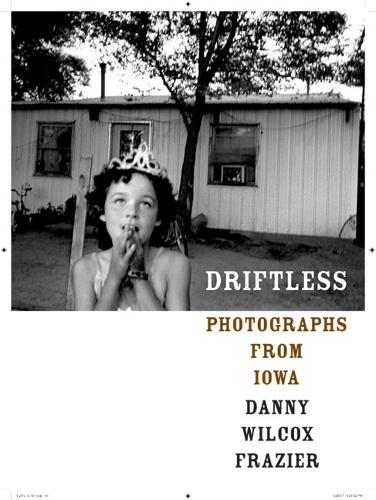
Книга Driftless: Photographs from Iowa
Dramatic black-and-white photographs portray a changing Midwest of vanishing towns and transformed landscapes
Winner of the third biennial Center for Documentary Studies/Honickman First Book Prize
Robert Frank, Prize Judge
In Driftless, Danny Wilcox Frazier’s dramatic black-and-white photographs portray a changing Midwest of vanishing towns and transformed landscapes. As rural economies fail, people, resources, and services are migrating to the coasts and cities, as though the heart of America were being emptied. Frazier’s arresting photographs take us into Iowa’s abandoned places and illuminate the lives of those people who stay behind and continue to live there: young people at leisure, fishermen on the Mississippi, veterans on Memorial Day, Amish women playing cards, as well as more recent arrivals: Lubavitcher Hasidic Jews at prayer, Latinos at work in the fields. Frazier’s camera finds these newcomers while it also captures activities that seemingly have gone on forever: harvesting and hunting, celebrating and socializing, praying and surviving.
This collection of photographs is a portrait of contemporary rural Iowa, but it is also more that that. It shows what is happening in many rural and out-of-the-way communities all over the United States, where people find ways to get by in the wake of closing factories and the demise of family farms. Taken by a true insider who has lived in Iowa his entire life, Frazier’s photographs are rich in emotion and give expression to the hopes and desires of the people who remain, whose needs and wants are complicated by the economic realities remaking rural America. Poetic and dark but illuminated with flashes of insight, Frazier’s stunning images evoke the brilliance of Robert Frank’s The Americans.
To view an image gallery, click here.
"“Driftless, shot in black-and-white film in a digital age, creates a lonely aura. Young people in trailers framed by beer-can pyramids. Harsh winter blizzards. Cold gun barrels. Old people in barren spaces. . . . Many of the photos are grainy because Frazier didn't use artificial lighting and had to 'push' the film speed. It lends a gritty reality to the shots.”" - Des Moines Register
"“[Frazier’s] pictures of people recall the street-kid photos of Helen Levitt, the active group images in Ben Shahn’s FSA work, and the famous book The Americans (1959), by Robert Frank, who judged the competition this book won. Elegiacism and a certain bitterness inform the album as a whole. No one looks prosperous; even the young partiers don’t seem cheery. Maybe they’ll all be living in cities in a year. Powerful stuff.”" - Booklist
"“The book is incredible for its raw intimacy and visual sophistication. . . .”" - Wired
"“Frazier presents a compelling look at life in contemporary Iowa. When chronicling just the land, Frazier portrays it in a harsh and biting manner through the use of high-contrast and grainy imagery. When documenting Iowa's people, Frazier plays the role of a fly on the wall. He is able to blend in with all sorts of characters in all types of situations, a hallmark of a well-rounded photojournalist. . . . Frazier's melancholy Driftless achieves success in the Iowan's choice to shoot in a style more concerned with content and free-flowing compositions than with the rigors of technical matters such as precise exposure and exacting horizon lines.”" - Chicago Sun-Times
"“Frazier’s images endeavor to shed light on the people and places that mainstream media neglects to illustrate. As rural economies fail, people and resources are migrating to the coasts and cities, altering rural America. Taken by an insider who has lived in Iowa his entire life, Frazier’s photographs show us these abandoned places and describe the lives of those people who stay behind. His approach is completely different than this spring’s news stories about Iowa’ spring flooding, which presumed that the impacts, although awful, were limited to the present; nowhere on national media were reports of the long lasting effects of the flooding on Iowa’s already unstable rural economy.”" - Rain Taxi