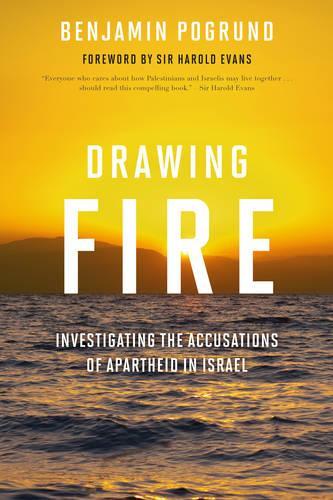
Книга Drawing Fire: Investigating the Accusations of Apartheid in Israel
Benjamin Pogrund, who spent 26 years as a journalist in South Africa investigating apartheid and who has been living in Israel for the past 15 years, investigates the accusation that Israel is practicing apartheid and the motives of those who make it. His study is founded on a belief in Israel, combined with frank criticism, to provide a balanced view of Israel’s strengths and problems. To understand Israel today, one must first look at the past and so the book first outlines key foundational events to explain current attitudes. It then explores the contradictions found in the region, including discrimination against Israeli Arabs and among Jews, before concluding that it is wrong to affix the apartheid label to Israel inside the Green Line of 1948/1967. It also deconstructs the criticisms of Israel and the boycott movement before arguing for two states, Israeli and Palestinian, as the only way forward for Jews and Arabs. This detailed and balanced study offers a unique comparison between South Africa and Israel and explains complex political and social situations in language accessible to all readers.
"If you want an informed opinion about whether Israel is an apartheid state. . . .Benjamin Pogrund is worth reading." - The Citizen
"[Drawing Fire: Investigating the Accusations of Apartheid in Israel] . . . will be valuable to anyone who genuinely seeks an understanding of the real situation on the ground, behind the political rhetoric." - South African Jewish Report
"At its best this book succeeds in providing valuable empirical resources that will enable its readers to question the totalising and distorted representations of the Israel-Palestine conflict that the apartheid analogy requires. . . .Drawing Fire is . . . most illuminating when it provides its readers with the information and argument that helps us understand the current conflict and the injustices to ordinary people that accompany it. . . .[In] spite of the author’s own best intentions, he is clearly worried that the occupation and settlement of Palestine is leading toward a situation in which the apartheid analogy looks more persuasive. The growth of a militant and loud anti-Arab racism within both the Israeli polity and society is a product of occupation that does not justify the apartheid analogy but may feed it if we are not careful. There is plenty to chew on in this worthy book." - Fathom
"[T]he book succeeds in his primary goal of showing that although there are some broad similarities between apartheid and Israeli reality, including the OPT, the term apartheid is simply not applicable to the latter. . . .Pogrund’s book is an eloquent statement of what some call 'liberal Zionism,' a humanistically based philosophy that advocates a sovereign state for Palestinians and equal rights for those with Israeli citizenship. . . .[T]he book is valuable as a statement of both hope and reality: that Israel retains the basis of a humanistically inclined country, that it is not an 'apartheid state,' and as an explication of what both Zionism and Israeli reality are and are not." - Palestine-Israel Journal
"This is an essential read for everyone who wants to persuasively confront the BDS movement." - Jewish Book Council
"What lends credence to Pogrund’s book are his impeccable anti-apartheid credentials…. From the late 1950s through the mid-1980s, a period covering the heyday of apartheid, he emerged as one of the most persistent and courageous journalists to expose the iniquities of that system, including the brutal suppression of political dissent by those it targeted…. Although drawing parallels between apartheid-era South Africa and modern-day Israel is damaging and misleading, Pogrund is among those who believe that Israelis and Palestinians can still learn from how South Africans successfully negotiated an end to apartheid and made a peaceful transition to non-racial democracy." - Israel Journal of Foreign Affairs