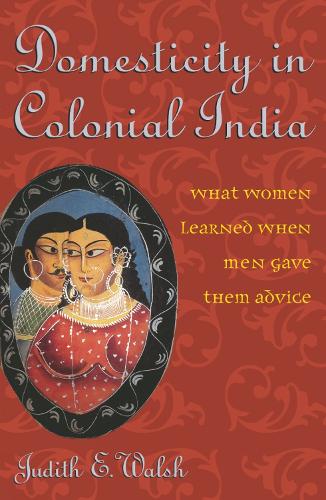
Книга Domesticity in Colonial India: What Women Learned When Men Gave Them Advice
Domesticity in Colonial India offers a trenchant analysis of the impact of imperialism on the personal, familial, and daily structures of colonized people's lives. Exploring the 'intimacies of empire,' Judith E. Walsh traces changing Indian gender relations and the social reconstructions of the late nineteenth century. She sets both in the global context of a transnationally defined discourse on domesticity and in the Indian context of changing family relations and redefinitions of daily and domestic life. By the 1880s, Hindu domestic life and its most intimate relationships had become contested ground. For urban, middle-class Indians, the Hindu woman was at the center of a debate over colonial modernity and traditional home and family life. This book sets this debate within the context of a nineteenth-century world where bourgeois, European ideas on the home had become part of a transnational, hegemonic domestic discourse, a 'global domesticity.' But Walsh's interest is more in hybridity than hegemony as she explores what women themselves learned when men sought to teach them through the Indian advice literature of the time. As a younger generation of Indian nationalists and reformers attempted to undercut the authority of family elders and create a 'new patriarchy' of more nuclear and exclusive relations with their wives, elderly women in extended Hindu families learned that their authority in family life (however contingent) was coming to an end. But young women learned a different lesson. The author draws on an important advice manual by a woman poet from Bengal and women's life stories from other regions of India to show us how young women used competing patriarchies to launch their own explorations of agency and self-identity. The practices of family, home, and daily life that resulted would define the Hindu woman of the twentieth and twenty-first centuries and the domestic worlds in which she was embedded.
"Walsh makes a good case for how elite women's agency was involved in escaping from abuse and exploitation by their in-laws. Recommended." - CHOICE
"Domesticity in Colonial India deals with women's reform in the late nineteenth-century colonial Calcutta. It traces the development of a reformist for women first promulgated by the Brahmo Samaj and gradually accepted by members of the English-educated, Bengali urban middle class known as bhadralok. Unlike other authors, Judith Walsh uses these findings to try to position women's reform in Bengal within a "global domesticity" produced reflexively in colony and metropole. This comparative approach to women's reform enhances the value of the book and opens up some interesting avenues for future research." - Journal of Asian Studies
"Judith Walsh's book adds to the scholarship on the re-shaping of gender roles in nineteenth-century Bengal by examining in detail a rarely discussed archive. Her English translations from this Bengali archive are valuable in their own right. Moreover, her comparative approach is one of the most stimulating aspects of this volume and opens up interesting possibilities for future research focusing on other regions of India. Further, the global breadth makes the book suitable for assignment in non-area specific women's studies courses." - Itinerario
"The book stimulates thought. Additionally this volume makes for an entertaining and lucid read. It should prove popular in undergraduate and graduate courses in Colonial Studies, Colonialism, Gender and Women's Studies as well as to the people who are just interested in the subject." - Journal Of Colonialism and Colonial History
"Domesticity in Colonial India tells the story of India's confrontation with a new colonial modernity that comes to be contested within the most intimate of everyday spaces: the home. . . . The book . . . offer[s] some wonderful examples of men tutoring their wives in the lessons of these manuals. . . . As this book reveals, understanding how the ideas that governed everyday life affected society and culture will help further our knowledge of domestic ideology as a culturally organizing principle that pervaded during the nineteenth century and beyond." - H-Net: Humanities and Social Science Reviews Online
"[A] genuinely comparative text…Walsh seeks to show domesticity’s complicity with colonial conquest….The great strength of this book is Walsh’s close attention to documenting how western ideas were learned, employed, and spread through their target populations." - Journal of Women's History