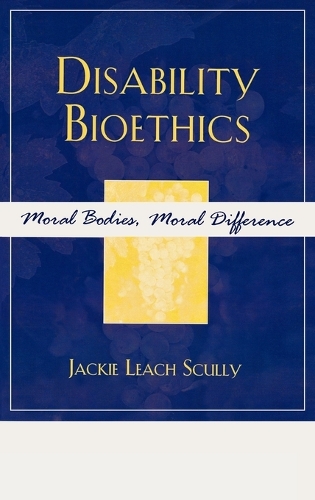
Книга Disability Bioethics: Moral Bodies, Moral Difference
Jackie Leach Scully argues that bioethics cannot avoid the task of considering the moral meaning of disability in humans - beyond simply regulating reproductive choices or new areas of biomedical research. By focusing on the experiential and empirical reality of impairment, and drawing on recent work in disability studies, Scully brings new attention to complex ethical questions surrounding disability. Impairment is variously considered as a set of social relations and practices, as experienced embodiment, and as an emancipatory movement, as well as a biomedical phenomenon. In this way, disability is joined to the general late-twentieth century trend of attending to difference as a significant and central axis of subjectivity and social life.
"In her wise, clear, and careful book, Jackie Leach Scully takes her place among the leaders of a second wave of disbility theory." - The New England Journal Of Medicine, November 20, 2008
"The detailed and reflective description of disability as a factor in shaping moral identity, and the consideration in the concluding chapters of the formation of groups with similar limitations as political or cultural communities, make this a unique and creative contribution to the moral issues of life with disabilities. This book will be valuable to professionals and individuals dealing practically with living in "different bodies." Very thorough bibliography and index. Highly recommended." - CHOICE, May 2009
"This book operates at the intersection of three debates: bioethics; biomedicine; and disability/Deaf studies. It is an excellent introduction for bioethicists and others who are unfamiliar with the challenge posed by disability studies. Not least because she is unafraid to deploy autobiography as part of her intellectual toolbox, Scully's personality comes through the pages of this book: accessible, thoughtful, with a dry wit. Scully is one of the deeper thinkers in contemporary disability studies, eschewing radical rhetoric in favor of detailed readings and carefully constructed arguments." - Metapsychology Online, August 4, 2009