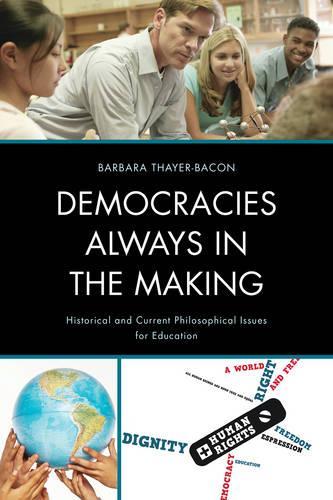
Книга Democracies Always in the Making: Historical and Current Philosophical Issues for Education
Democracies Always in the Making develops Barbara Thayer-Bacon’s relational and pluralistic democratic theory, as well as translates that socio-political philosophical theory into educational theory and recommendations for school reform in American public schools. John Dewey warned us long ago that a nation cannot hope to be a democracy someday without paying attention to how it educates its young future citizens. Democracy is a goal, an ideal which we must continually strive for that can guide us in our decision-making, as we continue to live in a world that is unpredictable, flawed, and limited in terms of its resources. There are key political philosophers of education who we can turn to for help. They offer us important ideas that will help us re-check our assumptions and critique our daily practice. Existing school models also offer us important examples of how to structure schools as well as various methodologies and curriculum that we can elect to use to help us move closer to the ideal of a democracy.
"In this provocative new book, Thayer-Bacon (Univ. of Tennessee) aims to dislodge democratic theory from its reliance on the extreme individualism of John Locke and Jean-Jacques Rousseau and in its place construct a transactional view of democracy that emphasizes epistemological and cultural pluralism and a relational view of selfhood. Drawing from a variety of feminist and postmodern perspectives, she makes a convincing case for a view of democracy that is always incomplete and unfinished, yet nevertheless provides the best orientation for educational (and other social) institutions. Thayer-Bacon accomplishes this by linking critical investigation of key theorists (Jacques Rancière, John Dewey, Paulo Freire, bell hooks, and others) to descriptive analysis of actual school projects, some of which are based on firsthand experience. Her treatment of Myles Horton and Maxine Greene are especially noteworthy. In her effort to canonize some theorists while demonizing others, however, she makes the occasional heavy-handed caricature. The historical record makes it very difficult to see Maria Montessori, for instance, as someone animated by a purely egalitarian spirit. Moreover, Thayer-Bacon's sharp, nearly ad hominem critique of Peter McLaren's work will likely raise eyebrows. Still, it is this contentiousness that will generate good discussion in graduate seminars. Summing Up: Highly recommended. Undergraduates, all levels, and above." - CHOICE