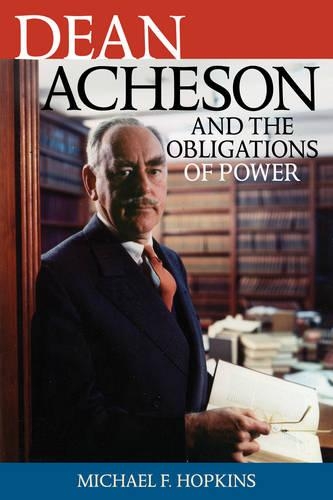
Книга Dean Acheson and the Obligations of Power
Dean Acheson was the most influential American diplomat of the twentieth century. He shaped the pivotal shift in American foreign policy from isolation to engagement in global affairs, This critical re-evaluation of Acheson’s public career analyzes his advocacy of intervention against Germany and Japan in 1939-1941, work on sanctions against Japan in 1941, contribution to the creation of new international institutions, and campaigns to secure the support of Congress and the American public. It scrutinizes his crucial role in the Truman Doctrine, the Marshall Plan, NATO, the formation of democratic governments in Germany and Japan, and involvement in the Korean War. It examines his advice on Europe and Vietnam to presidents Kennedy, Johnson and Nixon. Acheson was the architect of the policy of containing the Soviet Union that endured to the end of the Cold War. The book argues that Acheson was slower to abandon the prospect of understandings with the Soviets and the communists in China than his memoirs claim; his focus on the North Atlantic did not exclude his deep concern for Asian; and the policy of containment was part of his wider belief that American power brought the obligation to promote a stable international order.
"Diplomatic histories are an acquired taste, but this admirable addition to the American Foreign Policy Series from Hopkins (The Cold War), senior lecturer in American foreign policy at the University of Liverpool, maintains the series’ high standard of scholarship while eschewing the traditional turgid academic prose. This is not a biography, so Hopkins dispenses with Acheson’s early years in a few pages. Appointed U.S. Assistant Secretary of State in 1941, Acheson (1893–1971) exuded energy, showed a sophisticated grasp of international affairs and economics, and possessed a gift for getting along with most of his fellow bureaucrats and members of Congress. Acheson resigned in 1945 but was persuaded to return as Undersecretary and then Secretary of State from 1948–1953, when he oversaw the rebuilding of Europe and Japan as well as America’s rise to superpower status. Despite persistent abuse by Joe McCarthy and the China Lobby for what they saw as insufficient opposition to communism, Acheson managed America’s aggressive containment policy, which persisted until the U.S.S.R.’s collapse. During a long retirement, Acheson advised and worked for Presidents Kennedy, Johnson, and Nixon, and his speeches and writing place him with Henry Kissinger among America’s leading 20th-century diplomats. [The book]...is gratifyingly well-written and provides a definitive account of mid-20th-century U.S. foreign policy." - Publishers Weekly