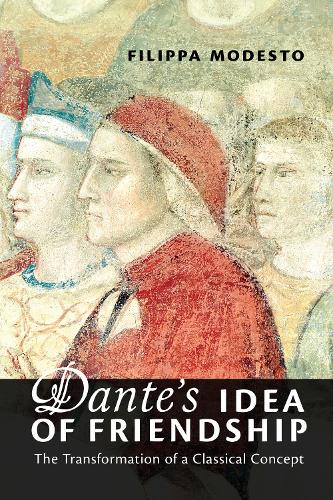
Книга Dante's Idea of Friendship: The Transformation of a Classical Concept
"At the heart of Filippa Modesto's book lies a passion for this rare gift known as friendship, and this passion expresses itself both as a love for the concrete quality of Dante's poetic vision and his linguistic inventiveness and as gratitude for her own friends. What gives a persuasive unity to her critical musings is her decision to map the shift from the classical, pagan understanding of the virtue of friendship to the Christian re-interpretation of it. The importance of the topic can hardly be exaggerated, and Modesto develops it with delicacy, gracefulness, and modesty." -- Giuseppe Mazzotta, Sterling Professor of Humanities for Italian, Yale University
In the ancient world, friendship was a virtue of great philosophical importance. Aristotle wrote extensively about it, as did Cicero. Their conception of friendship as a relationship based on reason and virtue was transformed by Christianity into a connection based on the mutual love of an individual and God.
In Dante’s Idea of Friendship, Filippa Modesto offers sharp readings of the Commedia, Vita Nuova, and Convivio that demonstrate Dante’s interest in that theme. Drawing on a lucid and wide-ranging examination of the literature on friendship, she shows how he weaved together the contradictory classical and the Christian concepts of friendship into a harmonious synthesis in which friendship became a handmaiden to salvation and happiness. A fresh, perceptive interpretation of Dante’s works, Dante’s Idea of Friendship will engage medievalists, classicists, and scholars of friendship throughout the ages.
"
‘This is a fascinating study… The book marks an important contribution to the historiography of architecture and urban planning… It offers perspectives that can inform the study of other cities.’
" - H-Italy, H-Net Reviews May 2017"
‘A solid contribution to Dante studies… It carefully explores a topic at the heart of classical and Christian understanding of the good life but which is usually neglected in criticism of Dante’s works.’
" - Speculum vol 93:02:2018