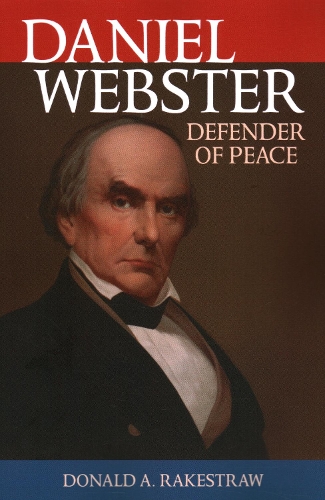
Книга Daniel Webster: Defender of Peace
Few names in American history are more recognizable than that of Daniel Webster. No one would deny that Webster’s substantive domestic achievements assured his prominent place in American history and that his virtual embodiment of nation and union guaranteed his rank among the most significant personalities of the Jacksonian era. It can, however, be argued that his domestic resumé that garnered him the title “Defender of the Constitution” is rivaled by an impressive international one that yielded far-reaching results for a nation still struggling to find a respectable position among the Atlantic powers. In fact, his adroit handling of his signature accomplishment with Lord Ashburton earned him the additional title of “Defender of Peace.” Webster’s foreign policy achievements are too often given short shrift, falling victim to the textbook author’s inclination to hold Webster to the dominant domestic narrative that would ultimately see the nation fractured. Donald A. Rakestraw focuses on Webster’s critical diplomatic efforts--efforts that produced a legacy that ranges from the delineation of America’s northeastern boundary with Canada to the prevention of a serious rupture with Britain; from the advancement of national commercial expansion in the Pacific and East Asia to the establishment of a long-lived model for U.S. extradition policy; from his successful intervention on behalf of the so-called “Santa Fe prisoners” in Mexico to his role in promoting a crucial Anglo-American rapprochement.
"Rakestraw (Winthrop Univ.) foregoes yet another comprehensive biography of this 19th-century American political giant, and instead provides a lean life study focusing on Webster’s diplomatic statecraft. Rakestraw's centerpiece (discussed in chapter 3) is Webster’s resolution, in his role as secretary of state in John Tyler’s cabinet, of a dispute with Great Britain over Maine’s Canadian boundary—a diplomatic maneuver that set Great Britain and the US “on a path to an epic partnership.” In 1842, through extensive negotiations with Alexander Barring (Lord Ashburton), Webster crafted a compromise that served the interests of both parties. It was his signal achievement as a diplomat. As secretary of state again from 1850 to 1852, Webster pursued commercial relations with China and Japan, discouraged filibustering in Central America, and promoted patriotism during a time of stress in the US over slavery-related issues, notably through his blustery defense of Hungarian freedom fighter Louis Kossuth. Webster’s diplomatic record included substantive achievements (keeping Hawaii in the American orbit) and unforced errors (making claims about the Lobos Islands in a controversy with Peru that did not stand scrutiny). Overall, Rakestraw argues, Webster demonstrated a pragmatic temper in the office and made his mark. This well-documented book makes for good reading and fills a niche in Webster studies.
Summing Up: Recommended. Graduate students, researchers, faculty." - Choice