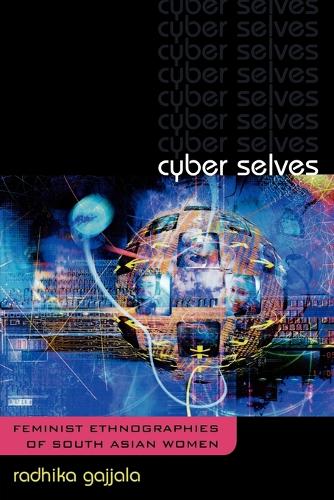
Книга Cyber Selves: Feminist Ethnographies of South Asian Women
In her new book Gajjala examines online community formations and subjectivities that are produced at the intersection of technologies and globalization. She describes the process of designing and building cyberfeminist webs for South Asian women's communities, the generation of feminist cyber(auto)ethnographies, and offers a third-world critique of cyberfeminism. She ultimately views virtual communities as imbedded in real life communities and contexts, with human costs. The online discussions are visible, textual records of the discourses that circulate within real life communities. Her methodology involves a form of 'cyberethnography,' which explores the dialogic and disruptive possibilities of the virtual medium and of hypertext. Gajjala's work addresses the political, economic, and cultural ramifications of the Internet communication explosion. This book will be a valuable reference for those with an interest in cultural studies, feminist studies, and new technologies.
"Using cyber-ethnographic methodology and feminist theoretical framwork, [Gajjala] has studies the structure and content of exchanges among paricipants (netizens) in these virtual communities to answer fundamental questions about virtual communities...Theauthor's critical and reflective analysis challenges students of feminist studies and of online communication studies to reconsider the assumption that internet communication in the globalized world is a power equalizerrrr" - Electronic Magazine Of Multicultural Education
"...an intriguing study..." - H-Net: Humanities and Social Science Reviews Online, February, 2008
"...insightful. It highlights several important issues, not only online practices that lead to an 'insider' becoming an 'outsider', but more importantly women only spaces on the Web." - Indian Journal Of Gender Studies
"Using cyber-ethnographic methodology and feminist theoretical framwork, [Gajjala] has studies the structure and content of exchanges among paricipants (netizens) in these virtual communities to answer fundamental questions about virtual communities...The author's critical and reflective analysis challenges students of feminist studies and of online communication studies to reconsider the assumption that internet communication in the globalized world is a power equalizer" - Electronic Magazine Of Multicultural Education