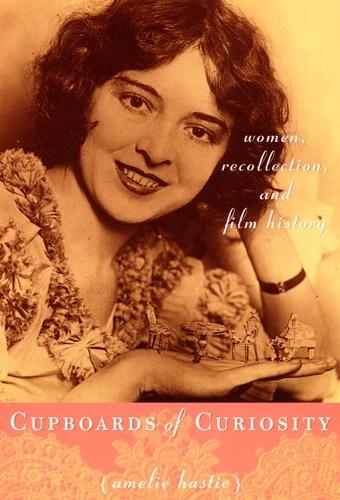
Книга Cupboards of Curiosity: Women, Recollection, and Film History
Examines the writings and collections of early women film stars in order to provide a greater analysis of their contributions to film history.
In Cupboards of Curiosity Amelie Hastie rethinks female authorship within film history by expanding the historical archive to include dollhouses, scrapbooks, memoirs, cookbooks, and ephemera. Focusing on women who worked during the silent-film era, Hastie reveals how female stars, directors, and others appropriated personal or “domestic” cultural forms not only to publicize their own achievements but also to reflect on specific films and the broader film industry. Whether considering Colleen Moore’s thirty-six scrapbooks or Dietrich’s eccentric book Marlene Dietrich’s ABC, Hastie emphasizes how these women spoke for themselves—as collectors, historians, critics, and experts—often explicitly contemplating the role their writings and material objects would play in subsequent constructions of history.
Hastie pays particular attention to the actresses Colleen Moore and Louise Brooks and Hollywood’s first female director, Alice Guy-Blaché. From the beginning of her career, Moore worked intently to preserve a lasting place for herself as a Hollywood star, amassing collections of photos, souvenirs, and clippings as well as a dollhouse so elaborate that it drew extensive public attention. Brooks’s short essays reveal how she participated in the creation of her image as Lulu and later emerged as a critic of film stardom. The recovery of Blaché’s role in film history by feminist critics in the 1970s and 1980s was made possible by the existence of the director’s own autobiographical history. Broadening her analytical framework to include contemporary celebrities, Hastie turns to how-to manuals authored by female stars, from Zasu Pitts’s cookbook Candy Hits to Christy Turlington’s Living Yoga. She discusses how these assertions of celebrity expertise in realms seemingly unrelated to film and visual culture allow fans to prolong their experience of stardom.
"“[A] very interesting new book. . . . Vacillating between memoir and history, Hastie shows that these women's personal scrapbooks—often seen as tangential to film history—provide vital links between ‘women and the margins of history into which they are often placed.’ A look back you can look forward to.”" - Santa Cruz Sentinel
"“[A]n enjoyable read and important scholarly work. Where Hastie excels is in the interstices of chapters—the ways in which women by historical and cultural necessity have had to negotiate the slippage between collector-historian-critic to ultimately, through collaboration, emerge as expert.”" - Women's Studies
"“Amelie Hastie’s Cupboards of Curiosity: Women, Recollection, and Film History is agile and meticulous. Hastie ranges across materials and objects which have remained on the edge of most accounts of film history. In this way, Cupboards of Curiosity is engaging and revealing. . . . Hastie’s curiosity about her topic is instilled in her reader who is asked to look inside the neglected cupboards of film history and, in doing so, herself become a collaborator.”" - Media International Australia
"“Feminist scholars have long been engaged in a project to recover lost female voices, and, obviously, this is especially challenging when looking at film actresses whose images were carefully manufactured by the Hollywood star system. Fortunately, these women left behind their own documents, as seemingly mundane as notes in the margin of a book, or as fantastical as a giant dollhouse. Their history resides in these records, and Hastie beautifully and respectfully lets them speak for themselves.”" - Journal of Popular Culture
"“There is much to commend in Amelie Hastie's imaginative, innovative, and feminist study of the intersections between memory, film history, and critical theory. Above all, Cupboards of Curiosity reveals new possibilities for recovering the oeuvre of women engaged in the creation of American film.”" - Journal of American History
"“This book transports easily and reads entertainingly. It examines important ideas from a conventional setting, reinventing them through a fresh perspective in a light, anecdotal tone.”" - M/C Reviews