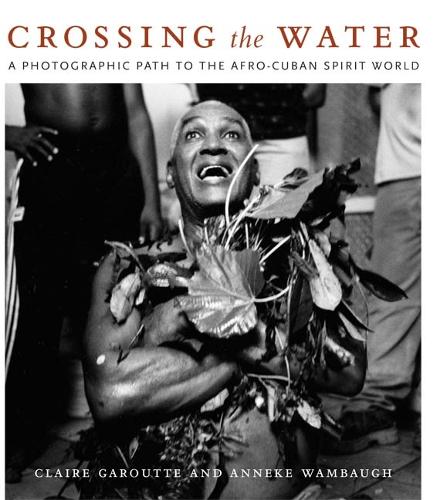
Книга Crossing the Water: A Photographic Path to the Afro-Cuban Spirit World
Textual and photographic exploration of the diversity and hybridity of Afro-Cuban religious practices, with a first-hand account by a practitioner
In the summer of 2000, two award-winning photographers, Claire Garoutte and Anneke Wambaugh, were researching Afro-Cuban religious practices in Santiago de Cuba, a city on the southeastern coast of Cuba. A chance encounter led them to the home of Santiago Castañeda Vera, a priest-practitioner of Santería, Palo Monte, and Espiritismo, a Cuban version of nineteenth-century European Spiritism. Out of that initial meeting, a unique collaboration developed. Santiago opened his home and many aspects of his spiritual practice to Garoutte and Wambaugh, who returned to his house many times during the next five years, cameras in hand. The result is Crossing the Water, an extraordinary visual record of Afro-Cuban religious experience.
A book of more than 150 striking photographs in both black and white and color, Crossing the Water includes images of elaborate Santería altars and Palo spirit cauldrons, as well as of Santiago and his religious “family” engaged in ritual practices: the feeding of the spirits, spirit possession, and private and collective healing ceremonies. As the charismatic head of a large religious community, Santiago helps his godchildren and others who consult him to cope with physical illness, emotional crises, contentious relationships, legal problems, and the hardships born of day-to-day survival in contemporary Cuba. He draws on the distinct yet intertwined traditions of Santería, Palo Monte, and Espiritismo to foster healing of both mind and body—the three religions form a coherent theological whole for him.
Santiago eventually became Garoutte’s and Wambaugh’s spiritual godfather, and Crossing the Water is informed by their experiences as initiates of Santería and Palo Monte. Their text provides nuanced, clear explanations of the objects and practices depicted in the images. Describing the powerful intensity of human-spirit interactions, and evoking the sights, smells, sounds, and choreography of ritual practice, Crossing the Water takes readers deep inside the intimate world of Afro-Cuban spirituality.
"“[A]n engaging and valuable ethnography in its own right, one that goes surprisingly far in its contribution to the field of Afro-Cuban religious studies. Written in sensitive and unpretentiously clear prose, the authors are astute observers of the social, emotional, and spiritual nuances of Cuban religious life, making of their foray a potential source of rich data for any scholar wishing to unravel the complex relationships between Afro-Cuban cosmology and practice, matter and deity, person and spirit.”" - Journal of the Royal Anthropological Institute
"“[A]n extraordinarily rich and detailed ethnographic undertaking combined with a highly personal engagement that is acknowledged and foregrounded throughout. It is this remarkable and beautiful combination of the visual, textual and personal that makes the book very powerful. . . .”" - Bulletin of Latin American Research
"“[F]rom a visual perspective Crossing the Water introduces one into an illuminating world of Afro-Cuban spiritualism. From a cultural and historical perspective the photographs provide a better understanding to viewers of the power of Afro-Cuban culture and religion and its impact on the people and their beliefs. Overall, Crossing the Water provokes intensity of human-sprit interactions, sights, smells, sounds, and a vivid choreography of ritual practice.”
" - The Latin Americanist
"[A] colorfully intimate portraiture of religious practice on the part of its authors. . . . [I]t provides, from its emic perspective, a close look at the quotidian practice of Santiago, a true priest of these 'crossed' religions and guide through their liturgies, rites, and arcane practices." - The Americas
"Photographers Garoutte and Wambaugh demystify and celebrate the Afro-Cuban religions of Santería, Palo Monte and Espiritismo. . . What results is a respectful, vibrant account of Afro-Cuban religions, enhanced by more than 150 vivid photographs." (Starred Review) - Publishers Weekly