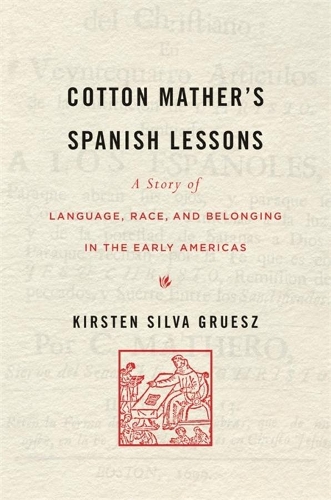
Книга Cotton Mather’s Spanish Lessons: A Story of Language, Race, and Belonging in the Early Americas
A sweeping history of linguistic and colonial encounter in the early Americas, anchored by the unlikely story of how Boston’s most famous Puritan came to write the first Spanish-language publication in the English New World.
The Boston minister Cotton Mather was the first English colonial to refer to himself as an American. He was also the first to author a Spanish-language publication: La Fe del Christiano (The Faith of the Christian), a Protestant tract intended to evangelize readers across the Spanish Americas. Kirsten Silva Gruesz explores the conditions that produced La Fe del Christiano, from the intimate story of the “Spanish Indian” servants in Mather’s household, to the fragile business of printing and bookselling, to the fraught overlaps of race, ethnicity, and language that remain foundational to ideas of Latina/o/x belonging in the United States today.
Mather’s Spanish project exemplifies New England’s entanglement within a partially Spanish Catholic, largely Indigenous New World. British Americans viewed Spanish not only as a set of linguistic practices, but also as the hallmark of a rival empire and a nascent racial-ethnic category. Guided by Mather’s tract, Gruesz explores English settlers’ turbulent contacts with the people they called “Spanish Indians,” as well as with Black and local native peoples. Tracing colonial encounters from Boston to Mexico, Florida, and the Caribbean, she argues that language learning was intimately tied with the formation of new peoples. Even as Spanish has become the de facto second language of the United States, the story of La Fe del Christiano remains timely and illuminating, locating the roots of latinidad in the colonial system of the early Americas.
Cotton Mather’s Spanish Lessons reinvents our understanding of a key colonial intellectual, revealing notions about language and the construction of race that endure to this day.
"In her revolutionary new book,…Gruesz sets aside Mather the witch hunter to center him instead in a fascinating new story about race…It is Gruesz’s thrillingly literary focus on a single text—spinning out as much significance as she has convincingly shown it deserves—that makes her new consideration of him so rewarding." - Los Angeles Review of Books
"A fascinating expedition into matters of race, language, and religion…That Gruesz can so convincingly link the miniscule actions of a late seventeenth-century printer in Boston with the huge contemporary issue of ethno-racial ambiguity in the US indicates the range and ambition of her book, fully achieved." - American Literary History
"As [Gruesz] revisits the life and writings of Mather especially as connected to his La Fe del Christiano, she illustrates that his significance went well beyond the basic religious world of New England, entangling him in the broader, imperial context of the early modern world." - H-Net Reviews
"A new narrative about race and ideas, as well as practices, of belonging, with deep and explicit implications for Latina/o/x history today…Gruesz’s ambitious and innovative book—both a macro history of language, ideas, and circulation and a micro history of Mather, his household, and his interactions with Native and Black people—should be widely read." - New England Quarterly
"Extraordinary…In many ways [Gruesz] expands what the biography of a text can achieve and shows how many aims it can encompass…Every early Americanist, from any discipline, should certainly read the introduction. Most should read the book in full. All will find insightful material to spur further studies. [This book] contains important lessons for us all." - William & Mary Quarterly
"Immersive and eye-opening…Meticulously researched and elegantly written, this is an essential reconsideration of the historical and contemporary place of the Spanish language and ‘Brown identity’ in the U.S." - Publishers Weekly