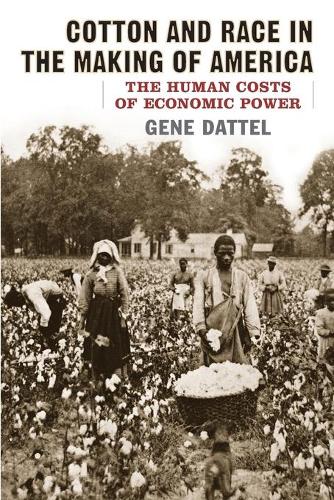
Книга Cotton and Race in the Making of America: The Human Costs of Economic Power
Since the earliest days of colonial America, the relationship between cotton and the African-American experience has been central to the history of the republic. America's most serious social tragedy, slavery and its legacy, spread only where cotton could be grown. Both before and after the Civil War, blacks were assigned to the cotton fields while a pervasive racial animosity and fear of a black migratory invasion caused white Northerners to contain blacks in the South. Gene Dattel's pioneering study explores the historical roots of these most central social issues. In telling detail Mr. Dattel shows why the vastly underappreciated story of cotton is a key to understanding America's rise to economic power. When cotton production exploded to satiate the nineteenth-century textile industry's enormous appetite, it became the first truly complex global business and thereby a major driving force in U.S. territorial expansion and sectional economic integration. It propelled New York City to commercial preeminence and fostered independent trade between Europe and the United States, providing export capital for the new nation to gain its financial "sea legs" in the world economy. Without slave-produced cotton, the South could never have initiated the Civil War, America's bloodiest conflict at home. Mr. Dattel's skillful historical analysis identifies the commercial forces that cotton unleashed and the pervasive nature of racial antipathy it produced. This is a story that has never been told in quite the same way before, related here with the authority of a historian with a profound knowledge of the history of international finance. With 23 black-and-white illustrations.
"Two themes, one explicit, one implicit, compete in this exploration of the link between the development of American capitalism and the devastation of the African-American community. The price of cotton as the determinant of America's destiny, influencing and even overcoming individual will and ethical behavior is the fully explicit one. . . . The secondary and competing theme is Northern complicity in the slave trade, the cotton economy, segregation, racism and the development of the black underclass in the North and South, with its destructive behavioral characteristics." - Publishers Weekly
"Don’t miss this one." - Delta Review
"This is an epic story with a deeply tragic element to it, as the book's subtitle makes clear; and Dattel explores it with a steeliness that raises the most serious questions about the nature of the American democratic experiment today." - The Defender Online Blog
"For many people, Gene Dattel's study will be an eye-opener guaranteed to change their idea of the American experience. . . . A narrative that is both an impressive work of history and an important sociological masterwork." - Foreword Reviews
"Although most of the facts in this book will be familiar, Dattel nicely draws together the literature on the cotton South, financial markets, and northern racism to make the compelling argument that the South's desire for cotton and northern complicity irrevocably altered American racial history. . . . Dattel's choice to conclude with a technological innovation fits well with one of his underlying themes: history is largely shaped by technology and finance." - H-Net: Humanities and Social Science Reviews Online
"This is a highly readable account of the centrality of cotton in any attempt to understand the dynamic historical interplay of race relations and economic development in the United States. Paraphrasing Marx, the book argues that without slavery there would have been no cotton and without cotton no modern industry. . . . Compelling." - The Antioch Review
"Independent scholar Dattel provides a thoughtful analysis of cotton's economic power and the ways in which it helped shape race relations in the U.S. . . . Recommended." - CHOICE
"Cotton and Race demonstrates clearly and coherently the importance of slavery and commodity agriculture to the economic history of the United States. . . . The book provides a satisfying overview of the scholarly literature and its findings. . . . It is the author's tone that makes this book useful, as well as the organization of material. . . . For the average student in a general U.S. history survey, or an upper-level class in southern business or history, Dattel hits the nail on the head." - Business History Review
"The book is as important as it is provocative. . . . Dattel makes a valuable contribution indeed." - The Journal Of Economic History
"Dattel connects these forces in a way that offers a fresh analysis of King Cotton's place in US history. . . . Dattel goes to great lengths to explicate how the arrangements of these banking, transportation, and manufacturing concerns affected life on southern farms. . . . A highly readable non-academic sweep through cotton's impact on American civilization, [the reader] will not be disappointed." - Agricultural History