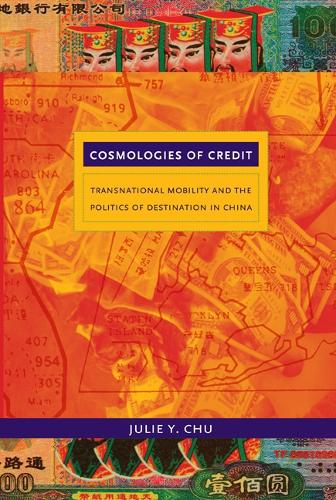
Книга Cosmologies of Credit: Transnational Mobility and the Politics of Destination in China
An ethnographic account of the desire for transnational mobility--largely via human smuggling networks--throughout Fuzhou, China
Year after year a woman sits in her bare living quarters with her bags packed. She is waiting for a phone call from her snakehead, or human smuggler. That longed-for call will send her out her door, away from Fuzhou, China, on a perilous, illicit journey to the United States. Nothing diffuses the promise of an overseas destiny: neither the ever-increasing smuggling fee for successful travel nor her knowledge of the deadly risks in transit and the exploitative labor conditions abroad. The sense of imminent departure enchants her every move and overshadows the banalities of her present life. In this engrossing ethnographic account of how the Fuzhounese translate their desires for mobility into projects worth pursuing, Julie Y. Chu focuses on Fuzhounese efforts to recast their social horizons beyond the limitations of “peasant life” in China. Transcending utilitarian questions of risks and rewards, she considers the overflow of aspirations in the Fuzhounese pursuit of transnational destinations. Chu attends not just to the migration of bodies, but also to flows of shipping containers, planes, luggage, immigration papers, money, food, prayers, and gods. By analyzing the intersections and disjunctures of these various flows, she explains how mobility operates as a sign embodied through everyday encounters and in the transactions of persons and things.
"“. . . [A] remarkably rich, sensitive ethnographic account. . . . Chu convincingly challenges conventional conceptions of place and displacement in the social analysis of migration and diaspora.”" - Asian Anthropology
"“Julie Chu's ambitious ethnography provides a captivating description of contemporary Chinese people's desire for mobility. . . . Cosmologies of Credit is daunting in scope and provides numerous insights for scholars interested in contemporary Chinese migration practice. . . . It is a major contribution to the fields both of migration and of China studies, and demonstrates the continued relevance of anthropological approaches to China's place in a globalized era.”" - The China Journal
"“The contradiction between the desired modern persona and the classically superstitious practices that are deployed to attain it has been noted by other researchers, but its ethnographic elaboration is one of the most interesting aspects of Chu’s book. Cosmologies of Credit enriches our understanding of the meshing between private and state desires of modernity that are so characteristic of today’s China.”" - The China Quarterly
"“This is a fine example of how a modern ethnography can be written in a way that informs about people’s lives without attempting to describe everything in a research site. It is also an example of how to write a transnational ethnography that transcends geographical boundaries. Unlike most anthropological works on China or on Chinese overseas which treat each as rather separate, this work links the study of China with the study of Chinese overseas very well.”" - Journal of Asian Studies
"“The study reveals a great deal about the conditions, motivations, and perceptions of the residents of the village with respect to their identities, opportunities, and how movement (especially economic and transnational) fits into their worlds…an important book for social scientists who study immigration, human smuggling, transnational movement, or nonurban society in contemporary China.” " - Religious Studies Review