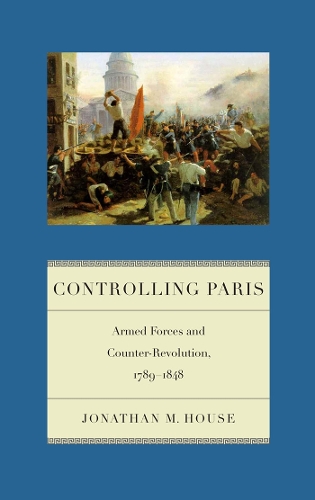
Книга Controlling Paris: Armed Forces and Counter-Revolution, 1789-1848
*offers us a study of revolution from the viewpoint of the government rather than the revolutionary.
When not at war, armies are often used to control civil disorders, especially in eras of rapid social change and unrest. But in nineteenth century Europe, without the technological advances of modern armies and police forces, an army’s only advantages were discipline and organization—and in the face of popular opposition to the regime in power, both could rapidly deteriorate. Such was the case in France after the Napoleonic Wars, where a cumulative recent history of failure weakened an already fragile army’s ability to keep the peace.
After the February 1848 overthrow of the last king of France, the new republican government proved remarkably resilient, retaining power while pursuing moderate social policies despite the concerted efforts of a variety of radical and socialist groups. These efforts took numerous forms, ranging from demonstrations to attempted coups to full-scale urban combat, and culminated in the crisis of the June Days. At stake was the future of French government and the social and economic policy of France at large.
In Controlling Paris, Jonathan M. House offers us a study of revolution from the viewpoint of the government rather than the revolutionary. It is not focused on military tactics so much as on the broader issues involved in controlling civil disorders: relations between the government and its military leaders, causes and social issues of public disorder, political loyalty of troops in crisis, and excessive use of force to control civil disorders. Yet somehow, despite all these disadvantages, the French police and armed forces prevented regime change far more often than they failed to do so.
"Houses book is not just a military history of civil repression. It puts the case for the army as an essential ingredient in modern politics, one which, in this instance, helped forge the character of nineteenth-century French republicanism." - War in History
"The first, most striking impression upon readingControlling Parisis that when seen from the perspective of those confronting the popular uprisings, the rebellion seems to have had extraordinary resources: secrecy and discipline of secret societies, combined with the amorphous and unpredictable power of the masses calling for social and economic change provided an advantage to the people." - The Journal of Modern History
"Most historians who have written about revolutionary movements in France have sympathized with the insurgents and told their stories from the point of view of the barricades. For this reason, House's decision to write a history of the Revolution of February-June 1848 from the vantage point of the forces of order is particularly striking . . . . Highly recommended." - Choice
"This thought-provoking study engages with a hidden dimension of the great Parisian revolutionary upheavals of the first half of the nineteenth centurythe extent to which insurgent successes and failures were shaped by the fluctuating strength of their opponents, the official forces of order. . . . [I]t does effectively demonstrate that revolutionary situations are, above all, confrontations of force, and that in such situations, the circumstances and motivations of both sides need to be taken into account in explaining their outcomes." - Journal of Interdisciplinary History
"Jonathan M. Houses book is perhaps the most comprehensive survey in English in the French forces of order during the revolutionary events of 1848. His discussion of the role and organization of the armed forces during and after the February Revolution is thorough and detailed." - Historian
"[] House has crafted a valuable addition to the history and literature of Paris and the French Revolution of 1848." - European History Quarterly