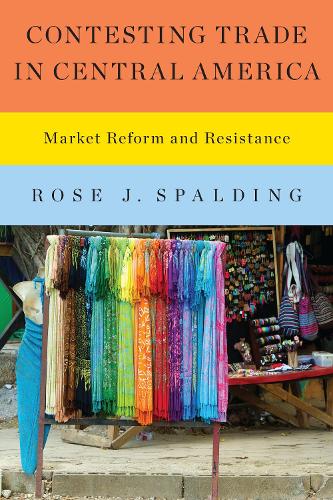
Книга Contesting Trade in Central America: Market Reform and Resistance
"The book provides us with a nuanced-and balanced-account that illustrates the ways in which the distinct political and economic histories of these three countries led to the process unfolding in varied ways among them... This is a very important contribution to the literature about market opening in Latin America." -- Laura Enriquez, Professor of Sociology, University of California, Berkeley "This work makes a significant contribution to the field in a number of ways... Scholars of social movements will be particularly interested in the rich discussion of the grassroots mobilization against CAFTA, which draws on both transnational social movement (TSM) theory and framing analysis... This book will be obligatory reading for anyone interested in free trade and social movement organizing in Central America." -- Richard Stahler-Sholk, Professor of Political Science, Eastern Michigan University
In 2004, the United States, five Central American countries, and the Dominican Republic signed the Central American Free Trade Agreement (CAFTA), signaling the region’s commitment to a neoliberal economic model. For many, however, neoliberalism had lost its luster as the new century dawned, and resistance movements began to gather force. Contesting Trade in Central America is the first book-length study of the debate over CAFTA, tracing the agreement’s drafting, its passage, and its aftermath across Central America.
Rose J. Spalding draws on nearly two hundred interviews with representatives from government, business, civil society, and social movements to analyze the relationship between the advance of free market reform in Central America and the parallel rise of resistance movements. She views this dynamic through the lens of Karl Polanyi’s “double movement” theory, which posits that significant shifts toward market economics will trigger oppositional, self-protective social countermovements. Examining the negotiations, political dynamics, and agents involved in the passage of CAFTA in Costa Rica, El Salvador, and Nicaragua, Spalding argues that CAFTA served as a high-profile symbol against which Central American oppositions could rally. Ultimately, she writes, post-neoliberal reform “involves not just the design of appropriate policy mixes and sequences, but also the hard work of building sustainable and inclusive political coalitions, ones that prioritize the quality of social bonds over raw economic freedom.”