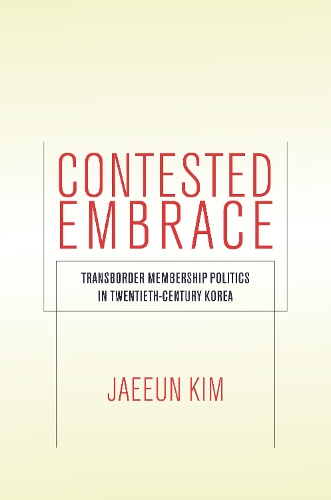
Книга Contested Embrace: Transborder Membership Politics in Twentieth-Century Korea
Scholars have long examined the relationship between nation-states and their "internal others," such as immigrants and ethnoracial minorities. Contested Embrace shifts the analytic focus to explore how a state relates to people it views as "external members" such as emigrants and diasporas. Specifically, Jaeeun Kim analyzes disputes over the belonging of Koreans in Japan and China, focusing on their contested relationship with the colonial and postcolonial states in the Korean peninsula.
Extending the constructivist approach to nationalisms and the culturalist view of the modern state to a transnational context, Contested Embrace illuminates the political and bureaucratic construction of ethno-national populations beyond the territorial boundary of the state. Through a comparative analysis of transborder membership politics in the colonial, Cold War, and post-Cold War periods, the book shows how the configuration of geopolitics, bureaucratic techniques, and actors' agency shapes the making, unmaking, and remaking of transborder ties. Kim demonstrates that being a "homeland" state or a member of the "transborder nation" is a precarious, arduous, and revocable political achievement.
"Contested Embrace sets a new standard in the study of migration and the state. Kim's theoretically agile and ethnographically vivid account shows how ordinary people and governments across Northeast Asia have wrestled over the question of who is Korean, and what that means in practice." - University of California, San Diego
"Contested Embrace is a brilliant and bracing analysis of transborder membership politics. Exhaustively researched and meticulously argued, Jaeeun Kim's book is required reading for anyone interested in modern Northeast Asia, comparative ethnicity and nationalism, and transnational and global studies. It is a great book to think with." - University of California, Berkeley
"This impressive work shows that neither instrumentalist nor culturalist views do justice to how states deal with their diaspora communities abroad and brings rare nuance to the vexed "transnationalism" problematic. Allergic to false binaries of many sorts, not least the one of micro v. macro, Contested Embrace is simply good sociology." - University of Bern
"Kim has meticulously utilized both historiographic and ethnographic approaches to dissect and analyze the discourse of belonging on the part of ethnic Koreans caught up in the violent and divisive historical developments in twentieth-century East Asia. Contested Embrace is a seminal work that integrates the historical, political, social, and economic experiences of diasporic Koreans in Japan and China vis-à-vis North and South Korea." - Pacific Affairs