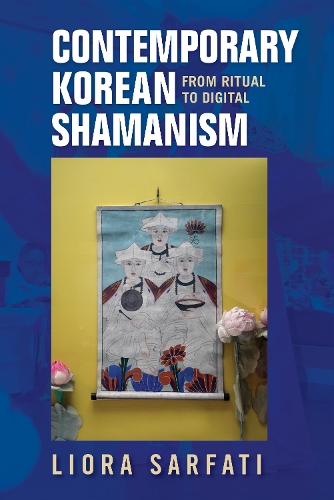
Once viewed as an embarrassing superstition, the theatrical religious performances of Korean shamans—who communicate with the dead, divine the future, and become possessed—are going mainstream. Attitudes toward Korean shamanism are changing as shamanic traditions appear in staged rituals, museums, films, and television programs, as well as on the internet.
Contemporary Korean Shamanism explores this vernacular religion and practice, which includes sensory rituals using laden altars, ecstatic dance, and animal sacrifice, within South Korea's hypertechnologized society, where over 200,000 shamans are listed in professional organizations. Liora Sarfati reveals how representations of shamanism in national, commercialized, and screen-mediated settings have transformed opinions of these religious practitioners and their rituals.
Applying ethnography and folklore research, Contemporary Korean Shamanism maps this shift in perception about shamanism—from a sign of a backward, undeveloped Korea to a valuable, indigenous cultural asset.
"
Contemporary Korean Shamanism is ethnographically based, uses a wide range of sources and materials, and contains extensive interviews with shamans both female and male (Korean shamans are predominantly female). The book does not discuss in detail specific individual rituals or shamanistic traditions, all of which can be found in other sources. It is principally about the transformation of the image of a religious tradition and how this occurred. As such, it is of interest not only to ethnographers, folklorists, and students of religion, but also to scholars concerned with social and cultural change.
" - Folklore