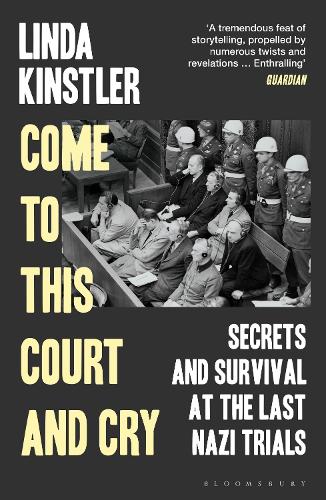
Книга Come to This Court and Cry: Secrets and Survival at the Last Nazi Trials
A probing and powerful personal history – and a debut from a remarkable new voice in non-fiction – about a family, an assassination, and the Holocaust on trial
A TABLET AND WALL STREET JOURNAL BOOK OF THE YEAR Shortlisted for the Wingate Literary Prize ‘A tremendous feat of storytelling, propelled by numerous twists and revelations, yet anchored by a deep moral seriousness . . . Enthralling‘ Guardian Across the world the last Nazi trials are winding their way through the courts. Nearly a century on from the Holocaust, survivors are still asked to give proof – and, in an era of rising revisionism and denialism, have their stories questioned. In this spellbinding debut, Linda Kinstler investigates both her family story and the archives of ten nations to ask: what does it take to prove history in our uncertain century? 'Reminds us of the dangerous instability of truth and testimony' Anne Applebaum 'Such a brilliant book – I couldn't put it down‘ Lea Ypi, author of Free 'Outstanding' Philippe Sands, author of East West Street ‘Astonishing‘ Patrick Radden Keefe, author of Empire of Pain
"Victims and perpetrators meet in Kinstler’s bloodline, but family history is only one strand of a remarkable book that braids together her own rigorously reported investigations in 10 countries with the survivors’ eight-decade quest for justice and poetic meditations on such subjects as history, law, Latvian identity, Franz Kafka and the politics of remembrance. This is a tremendous feat of storytelling, propelled by numerous twists and revelations, yet anchored by a deep moral seriousness" - Guardian
"Combines meticulous historical research with philosophical inquiries into nationalism, holocaust denial, guilt and the burden of proof. This is an invaluable and highly readable account of not only one family’s story, but also of a period on the cusp of passing from living memory" - New Internationalist
"[A] remarkable new book . . . There is a complex and powerful family story here . . . Asks large questions about the capacity of historical and legal practice to encompass the moral horror of the Holocaust, and about what justice is, or has ever been, possible" - The Critic
"Come to This Court and Cry is a reminder that memory is fallible, that the desire for forgetting is strong and that, when it comes to a subject so bitterly contested for so long, truth is all the more unstable" - Literary Review
"Exploring the tension between the justice of the courtroom and the retribution of assassination, the logic of the law and the frailty of memory, Linda Kinstler’s intelligent and thoughtful study Come to This Court and Cry utilises the story of Latvia’s wartime experience to meditate on the limits of the postwar reckoning with the Final Solution" - Times Literary Supplement
"The book, Ms. Kinstler’s first, is an exquisite exploration into ‘how the memory of the Holocaust extends into the present and acts upon it’" - Wall Street Journal
"In this gripping book, author Kinstler asks: was my grandfather a war criminal? … Kinstler chronicles her tireless investigation into anything she can glean about the life (and death) of grandfather Boris. At times, it acquires the qualities of an Agatha Christie spy novel. But she also raises fundamental philosophical issues … the gripping volume ends with more questions than answers" - Jewish Chronicle
"There has never been a better time to read a book such as this…As a historian, she is engaged in neither flight nor fight. She skillfully invites readers into the complexity of her craft" - Sydney Morning Herald
"Avoiding any simplistic or definitive conclusions, Kinstler provides a model of deep historical research and fluid, engaging narrative" - New York Journal of Books
"[A]n exquisite exploration" - Wall Street Journal
"She traces its twists and turns with patience, care, and a burning sense of integrity, bringing the reader into an answerless place between conflicting witness testimonies, between history and literary narratives, and between what is recorded as evidence and what is otherwise passed down or felt" - Jewish Currents
"[A] gripping debut … a deeply researched, engrossing and important look at how Holocaust stories have been passed down and altered" - Washington Post