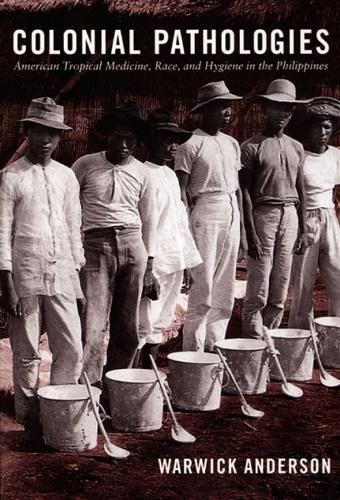
Книга Colonial Pathologies: American Tropical Medicine, Race, and Hygiene in the Philippines
A study of the promotion of hygiene and bodily reform in the colonial Philippines.
Colonial Pathologies is a groundbreaking history of the role of science and medicine in the American colonization of the Philippines from 1898 through the 1930s. Warwick Anderson describes how American colonizers sought to maintain their own health and stamina in a foreign environment while exerting control over and “civilizing” a population of seven million people spread out over seven thousand islands. In the process, he traces a significant transformation in the thinking of colonial doctors and scientists about what was most threatening to the health of white colonists. During the late nineteenth century, they understood the tropical environment as the greatest danger, and they sought to help their fellow colonizers to acclimate. Later, as their attention shifted to the role of microbial pathogens, colonial scientists came to view the Filipino people as a contaminated race, and they launched public health initiatives to reform Filipinos’ personal hygiene practices and social conduct.
A vivid sense of a colonial culture characterized by an anxious and assertive white masculinity emerges from Anderson’s description of American efforts to treat and discipline allegedly errant Filipinos. His narrative encompasses a colonial obsession with native excrement, a leper colony intended to transform those considered most unclean and least socialized, and the hookworm and malaria programs implemented by the Rockefeller Foundation in the 1920s and 1930s. Throughout, Anderson is attentive to the circulation of intertwined ideas about race, science, and medicine. He points to colonial public health in the Philippines as a key influence on the subsequent development of military medicine and industrial hygiene, U.S. urban health services, and racialized development regimes in other parts of the world.
"“Colonial Pathologies is a highly original work that, through the anxious eyes of its American architects, successfully illuminates the multidimensional U. S. colonial-medical state in the early twentieth-century Philippines. It has much to teach scholars about U. S. empire building, colonial medicine, race, and gender.”" - Bulletin of the History of Medicine
"“Colonial Pathologies is a path-breaking study of an aspect of late colonialism that is all too frequently neglected: imperial medicine. Anderson demonstrates how hygiene and sanitation became the hallmarks of a distinctly Americanised ‘civilising process’ that attempted to impose foreign rule over an archipelago of subjects and protect those entrusted with its mission from the baneful effects of having to do so in a tropical setting.”" - Anthropological Forum
"“Anderson has done an extraordinarily thorough job of research, and he skillfully employs the rich material he found regarding several key players. . . . Colonial Pathologies helps us understand just how complex and changing the reciprocal interactions between various imperial projects—in this case, the American project in the Philippines—and Western medical thinking really were.”" - Pacific Historical Review
"“Anderson's achievement . . . One of the finest and most finely nuanced accounts yet of colonial medicine in Asia (or, indeed, its sister continents), Colonial Pathologies provides an accessible narrative which students of European and American public health would read with profit.”" - Social History of Medicine
"“Warwick Anderson’s scholarship is well known for its intellectual rigor and its stimulating originality. . . . Without ignoring the particularities of the colonial history of the Philippines or of ‘American way’ of public health, Anderson offers above all, in my view, a fine reflection on the culture of biomedicalization, the questions of power and the negotiations that are part of the process, and the unexpected results that emerge, both locally and globally.”" - American Ethnologist