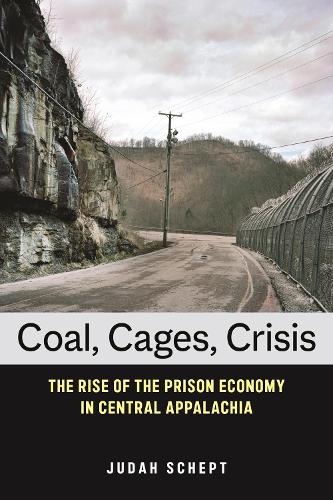
Книга Coal, Cages, Crisis: The Rise of the Prison Economy in Central Appalachia
How prisons became economic development strategies for rural Appalachian communities
As the United States began the project of mass incarceration, rural communities turned to building prisons as a strategy for economic development. More than 350 prisons have been built in the U.S. since 1980, with certain regions of the country accounting for large shares of this dramatic growth. Central Appalachia is one such region; there are eight prisons alone in Eastern Kentucky. If Kentucky were its own country, it would have the seventh highest incarceration rate in the world. In Coal, Cages, Crisis, Judah Schept takes a closer look at this stunning phenomenon, providing insight into prison growth, jail expansion and rising incarceration rates in America’s hinterlands.
Drawing on interviews, site visits, and archival research, Schept traces recent prison growth in the region to the rapid decline of its coal industry. He takes us inside this startling transformation occurring in the coalfields, where prisons are often built on top of old coalmines, including mountaintop removal sites, and built into community planning approaches to crises of unemployment, population loss, and declining revenues. By linking prison growth to other sites in this landscape—coal mines, coal waste, landfills, and incinerators—Schept shows that the prison boom has less to do with crime and punishment and much more with the overall extraction, depletion, and waste disposal processes that characterize dominant development strategies for the region.
Schept argues that the future of this area now hangs in the balance, detailing recent efforts to oppose its carceral growth. Coal, Cages, Crisis offers invaluable insight into the complex dynamics of mass incarceration that continue to shape Appalachia and the broader United States.
"The primary insight guiding Coal, Cages, and Crisis is that the carceral facility is part of an ensemble of social relations extending far beyond its walls, in networks of local, state, and federal punishment, the global landscape of commodity exchange, and even the unique historical moment in which it exists. As Schept deftly demonstrates, the site selection, construction, staffing, filling, and subsequent management of prisons and jails is not simply the narrow domain of the misnamed ‘justice system,’ reflecting its needs, nor are prisons and punishment regimes simply deployed in response to changing levels of ‘crime,’ as conservative criminologists argue. Instead, understanding why prisons are built, and filled, requires a close look at local patterns of employment, relations of private property, histories of structural racism, and the political and cultural arenas in which regimes of prison construction and ‘tough on crime’ policies alike are fought out … Time and again, Coal, Cages, Crisis strives to communicate that mass incarceration is not natural or inevitable, and depicts plenty of locals who prove that another way of life is not only possible, but in demand." - The Brooklyn Rail
"Drawing on interviews, site visits, and archival research, Schept links prison growth to other sites in the Central Appalachian landscape—coal mines, coal waste, landfills, and incinerators. He concludes that the prison boom has less to do with crime and punishment and much more with the overall extraction, depletion, and waste disposal processes that characterize dominant development strategies for the region." - Law and Social Inquiry
"Through this interdisciplinary study of the rural prison boom, Schept provides an invaluable state of the field in carceral and Appalachian studies, using the lens of racial capitalism to interpret the region’s complex identity. He also gives an innovative model for the use of blended oral and archival historical methods to study deep historical processes that manifest in the recent past." - The Journal of Southern History
"Prisons have proven to be unsafe and costly to operate and, as a result, many in this region have been closing at a rapid rate.…Highly recommended. Advanced undergraduates through faculty." - CHOICE