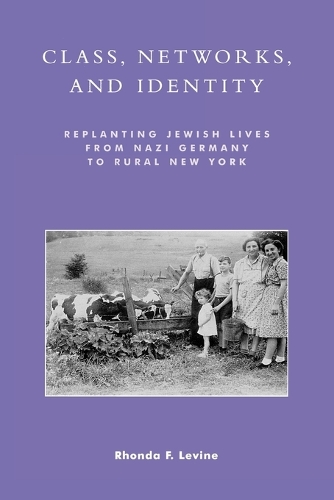
Книга Class, Networks, and Identity: Replanting Jewish Lives from Nazi Germany to Rural New York
This book documents a little-known aspect of the Jewish experience in America. It is a fascinating account of how a group of Jewish refugees from Nazi Germany came to dominate cattle dealing in south central New York and maintain a Jewish identity even while residing in small towns and villages that are overwhelmingly Christian. The book pays particular attention to the unique role played by women in managing the transition to the United States, in helping their husbands accumulate capital, and in recreating a German Jewish community. Yet Levine goes further than her analysis of German Jewish refugees. She also argues that it is possible to explain the situations of other immigrant and ethnic groups using the structure/network/identity framework that arises from this research. According to Levine, situating the lives of immigrants and refugees within the larger context of economic and social change, but without losing sight of the significance of social networks and everyday life, shows how social structure, class, ethnicity, and gender interact to account for immigrant adaptation and mobility.
"Levine has done the readers of this book an important service in two ways. She has captured with enormous sensitivity an interesting part of American Jewish history. At the same time, she has provided students of sociology with a rich case study that demonstrates the intersection of social networks and the nature of ethnic identity." - Jewish Book World
"Sophisticated and satisfying. By depicting the variables of social structure, class, and gender, as well as past group historical experience and contemporary historical reality that need to be considered when trying to understand immigrant socioeconomic adaptation and identity formation, Levine has made a singular contribution to understanding immigrant and ethnic mobility. All academic levels." - CHOICE
"A valuable contribution to the ethnography of American Jewry and the sociology of immigration processes. The book is well-written, tightly organized, and accessible, and it will be a useful case study for scholars and teachers in rural sociology, immigration studies, and Jewish studies." - Contemporary Sociology
"A valuable contribution to the ethnography of American Jewry and the sociology of immigration process. Levine has created a valuable picture of an immigrant experience previously neglected by sociological studies. The book is well-written, tightly organized, and accessible, and it will be a useful case study for scholars and teachers in rural sociology, immigration studies, and Jewish studies." - Community, Environment, and Population
"It is an interesting work." - Journal of American Ethnic History
"A well-researched and engagingly presented study. An interesting and useful study that historians and sociologists of immigration should add to their collections. It will also be of interest to students of gender relations and to those seeking to link different-level dimensions of social life in their analysis." - American Journal of Sociology