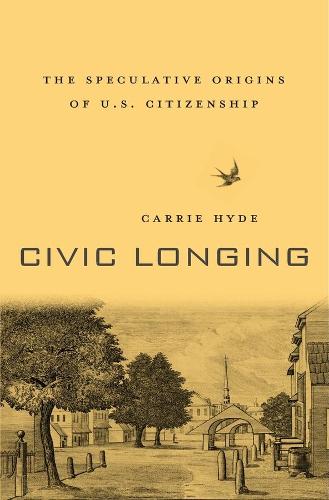
Книга Civic Longing: The Speculative Origins of U.S. Citizenship
Citizenship defines the U.S. political experiment, but the modern legal category that it now names is a relatively recent invention. There was no Constitutional definition of citizenship until the ratification of the Fourteenth Amendment in 1868, almost a century after the Declaration of Independence. Civic Longing looks at the fascinating prehistory of U.S. citizenship in the years between the Revolution and the Civil War, when the cultural and juridical meaning of citizenship—as much as its scope—was still up for grabs. Carrie Hyde recovers the numerous cultural forms through which the meaning of citizenship was provisionally made and remade in the early United States.
Civic Longing offers the first historically grounded account of the formative political power of the imaginative traditions that shaped early debates about citizenship. In the absence of a centralized legal definition of citizenship, Hyde shows, politicians and writers regularly turned to a number of highly speculative traditions—political philosophy, Christian theology, natural law, fiction, and didactic literature—to authorize visions of what citizenship was or ought to be. These speculative traditions sustained an idealized image of citizenship by imagining it from its outer limits, from the point of view of its “negative civic exemplars”—expatriates, slaves, traitors, and alienated subjects.
By recovering the strange, idiosyncratic meanings of citizenship in the early United States, Hyde provides a powerful critique of originalism, and challenges anachronistic assumptions that read the definition of citizenship backward from its consolidation in the mid-nineteenth century as jus soli or birthright citizenship.
"Impressive…Traces the retroactive and fluctuating ways in which citizenship has been defined in the United States since the days of the Founding Fathers." - Australian Book Review
"Hyde’s excellent book makes a strong case for the role of culture and literature in shaping American understandings of what it meant to be a member of the nation in the era before the 14th amendment asserted law’s authority." - Civil War Book Review
"Hyde takes the reader on an intellectual grand tour of citizenship as it has applied to the American context. That tour includes references to Western ‘contract’ theorists, the founders, the Declaration of Independence, U.S. Supreme Court decisions, and anti-slavery writers." - Choice
"Hyde makes a persuasive case for the importance of literature to the development of American understandings of citizenship…Hyde’s book is one that historians will need to ponder." - American Historical Review
"Civic Longing provides an exciting new framework for evaluating the political influence of literature in the antebellum nation…Conceptualizing citizenship through literary renderings of displacement marks this bookʼs most significant contribution to the field. By shifting our understanding of citizenship from an experience of collective belonging to an imaginative experience of longing, Hydeʼs work provides a new way to think about the political influence of literature and the sentimental dynamics of national affiliation." - William and Mary Quarterly
"Civic Longing is extremely valuable for its exploration of genres that legal scholars would not traditionally turn to when tracing the ancestry of our modern conception of citizenship. These alternative sources offer some important insights into how imagined citizenship affects the development of legal constructs…Hyde’s analysis is sophisticated and detailed. Her mastery of her selected sources is impressive, and the conclusions she draws from these sources are persuasive." - Tulsa Law Review
"Astute…Hyde is particularly adept at using interdisciplinary, sociohistorical materials to uncover the ways in which the concept of citizenship evolved from the late eighteenth century to the nineteenth…Offer[s] new ways to suggest how evolving concepts of belonging were formed across different forms of media, including court cases, novels, short stories, and newspapers." - Early American Literature