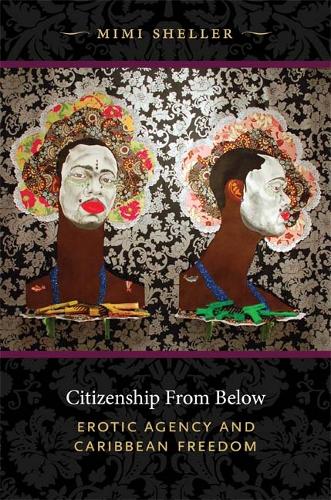
Книга Citizenship from Below: Erotic Agency and Caribbean Freedom
This comparative feminist work starts with a substantial historical account of the different ways that freedom, race and gender were intertwined in Jamaica and Haiti after the end of slavery. Newly free men and women were rebound into a racialized class order with acceptable and unacceptable forms of masculinity and femininity - what the author calls embodied freedom. Sheller traces these histories of racialized and sexualized forms of freedom to the present, where, using tools from feminist geography, she examines the contemporary gendered spaces of citizenship, travel, and popular culture across the Caribbean.
Citizenship from Below boldly revises the history of the struggles for freedom by emancipated peoples in post-slavery Jamaica, post-independence Haiti, and the wider Caribbean by focusing on the interplay between the state, the body, race, and sexuality. Mimi Sheller offers a new theory of "citizenship from below" to describe the contest between "proper" spaces of legitimate high politics and the disavowed politics of lived embodiment. While acknowledging the internal contradictions and damaging exclusions of subaltern self-empowerment, Sheller roots out from beneath the historical archive traces of a deeper freedom, one expressed through bodily performances, familial relationships, cultivation of the land, and sacred worship.
Attending to the hidden linkages among intimate realms and the public sphere, Sheller explores specific struggles for freedom, including women's political activism in Jamaica; the role of discourses of "manhood" in the making of free subjects, soldiers, and citizens; the fiercely ethnonationalist discourses that excluded South Asian and African indentured workers; the sexual politics of the low-bass beats and "bottoms up" moves in the dancehall; and the struggle for reproductive and LGBT rights and against homophobia in the contemporary Caribbean. Through her creative use of archival sources and emphasis on the connections between intimacy, violence, and citizenship, Sheller enriches critical theories of embodied freedom, sexual citizenship, and erotic agency in all post-slavery societies.
"“Citizenship from Below is a sophisticated, challenging, and ambitious book…. Sheller’s book is a masterful demonstration of the multidirectional, complicated, and ongoing process by which citizenship is constructed, appropriated, defined, and inhabited.… This book will be important and illuminating reading for historians of the Caribbean, of sex and gender, of citizenship, broadly conceived. It is indispensible reading for scholars interested in the fraught process of citizenship after slave emancipation, in particular.”" - Itinerario
"“Sheller joins this conversation on sexuality and social justice, with Citizenship from Below, which will be a useful tool in such dialogues—as well as in the hands of those ‘from below.’”" - Women's Review of Books
"“[A] grounded, yet expansive contribution to the study of sexuality, citizenship and post-slavery societies.”" - Anthurium
"[A]n extremely forceful and timely argument. . . . For Sheller, the exercise of sexual agency, while it may not necessarily transform the institutions through which inequalities have historically been structured, 'may enable some forms of maneuver, negotiation, and exchange' (p. 260). It is by training this lens on nineteenth-century Jamaica and Haiti that Sheller most profoundly complexifies traditional political histories of slavery, freedom, and citizenship. I believe this theoretical reframing is the most critical contribution of Citizenship from Below." - New West Indian Guide
" "A ground-breaking interdisciplinary achievement and contribution to the theory of freedom."" - Anthropological Notebooks