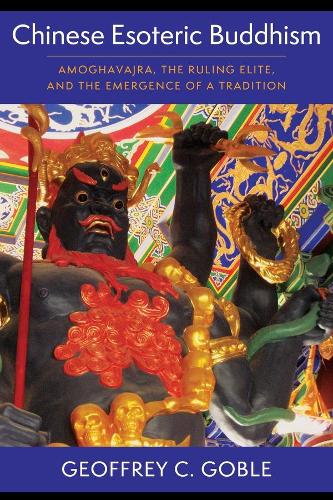
Книга Chinese Esoteric Buddhism: Amoghavajra, the Ruling Elite, and the Emergence of a Tradition
Chinese Esoteric Buddhism is generally held to have been established as a distinct and institutionalized Buddhist school in eighth-century China by “the Three Great Masters of Kaiyuan”: Śubhākarasiṃha, Vajrabodhi, and Amoghavajra. Geoffrey C. Goble provides an innovative account of the tradition’s emergence that sheds new light on the structures and traditions that shaped its institutionalization.
Goble focuses on Amoghavajra (704–774), contending that he was the central figure in Esoteric Buddhism’s rapid rise in Tang dynasty China, and the other two “patriarchs” are known primarily through Amoghavajra’s teachings and writings. He presents the scriptural, mythological, and practical aspects of Chinese Esoteric Buddhism in the eighth century and places them in the historical contexts within which Amoghavajra operated. By telling the story of Amoghavajra’s rise to prominence and of Esoteric Buddhism’s corresponding institutionalization in China, Goble makes the case that the evolution of this tradition was predicated on Indic scriptures and practical norms rather than being the product of conscious adaptation to a Chinese cultural environment. He demonstrates that Esoteric Buddhism was employed by Chinese rulers to defeat military and political rivals. Based on close readings of a broad range of textual sources previously untapped by English-language scholarship, this book overturns many assumptions about the origins of Chinese Esoteric Buddhism.
"Richly detailed study . . . this meticulous work will appeal to those interested in Chinese history in general as well as those studying Tang dynasty China, esoteric Buddhism, or Buddhism in China." - Choice
"Goble’s Chinese Esoteric Buddhism is an ambitious new look into the life of a well-known but still mysterious Esoteric Buddhist patriarch. . . this book serves as a vital contribution to the ever-evolving contemporary dialogue among scholars on how precisely Esoteric Buddhism should be understood." - Journal of Buddhist Ethics
"Goble's study of Amoghavajra is a classic case of how a religious tradition emerges and is, or in the case of Esoteric Buddhism in China is not, sustained over time. Therefore, historians of religion will find Goble's presentation of Amoghavajra and Chinese Esoteric Buddhism a worthwhile read." - Reading Religion
"Anyone with an interest in Chinese religion have much to gain from reading this." - Religious Studies Review