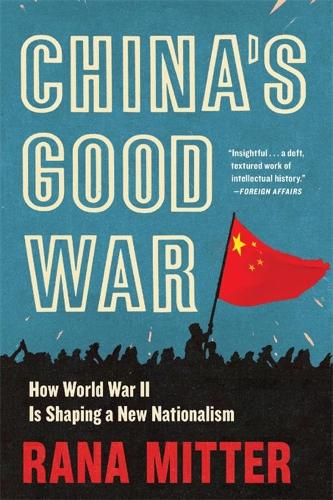
Книга China’s Good War: How World War II Is Shaping a New Nationalism
A Foreign Affairs Book of the Year
A Spectator Book of the Year
“Insightful…a deft, textured work of intellectual history.”
—Foreign Affairs
“A timely insight into how memories and ideas about the second world war play a hugely important role in conceptualizations about the past and the present in contemporary China.”
—Peter Frankopan, The Spectator
For most of its history, China frowned on public discussion of the war against Japan. But as the country has grown more powerful, a wide-ranging reassessment of the war years has been central to new confidence abroad and mounting nationalism at home.
Encouraged by reforms under Deng Xiaoping, Chinese scholars began to examine the long-taboo Guomindang war effort, and to investigate collaboration with the Japanese and China’s role in the post-war global order. Today museums, television shows, magazines, and social media present the war as a founding myth for an ascendant China that emerges as victor rather than victim. One narrative positions Beijing as creator and protector of the international order—a virtuous system that many in China now believe to be under threat from the United States. China’s radical reassessment of its own past is a new founding myth for a nation that sees itself as destined to shape the world.
“A detailed and fascinating account of how the Chinese leadership’s strategy has evolved across eras…At its most interesting when probing Beijing’s motives for undertaking such an ambitious retooling of its past.”
—Wall Street Journal
“The range of evidence that Mitter marshals is impressive. The argument he makes about war, memory, and the international order is…original.”
—The Economist
"One of Britain’s foremost historians of modern China…A detailed and fascinating account of how the Chinese leadership’s strategy has evolved across eras—and how its recent overtures to regional and international audiences have corresponded to shifts in domestic education and internal propaganda about World War II…China’s Good War is at its most interesting when probing Beijing’s motives for undertaking such an ambitious retooling of its past in the first place." - Wall Street Journal
"Excellent…[By] one of the world’s leading Sinologists…Allow[s] the reader—and the next US administration—to prepare for what China may do next." - Financial Times
"A timely insight into how memories and ideas about the second world war play a hugely important role in conceptualizations about the past and the present in contemporary China." - The Spectator
"The range of evidence that Mitter marshals is impressive. The argument he makes about war, memory, and the international order is…original." - The Economist
"Fascinating…An excellent guide to Chinese historiography…Mitter has written an important book that should serve to counter some of the cruder ways in which China is being misrepresented in the United States." - Literary Review
"Illuminates the fraught and complex manner in which historical memory functions in modern China." - Los Angeles Review of Books
"Insightful…Mitter opens a window into the legacy of China’s experience of World War II, showing how historical memory lives on in the present and contributes to the constant evolution of Chinese nationalism. In this deft, textured work of intellectual history, he introduces readers to the scholars, filmmakers, and propagandists who have sought to redefine China’s experience of the war…Yet Mitter does not shy away from exposing some of the political fictions that the CCP imposes on China’s past—to the detriment of its attempt to craft a persuasive narrative about China’s future." - Foreign Affairs
"Mitter’s most penetrating observations relate to how ordinary people have used contested memories of China’s good war to implicitly critique the Communist Party’s attacks on Chinese people…Shows how conversations about one proud part of China’s history are in fact conversations about more recent traumas." - Times Literary Supplement
"A fascinating read that examines China’s growing nationalism with a longer lens than most." - The Wire China
"Explains how Beijing once underplayed the war, but it has now become a keystone of its claims to legitimacy and to regional hegemony." - Foreign Policy
"Mitter chronicles the changing tides of official wartime narrative in China…China’s Good War is clear that national narratives are rarely based on historical scholarship, but rather on external politics." - South China Morning Post
"Rana Mitter has been researching and teaching about China’s Second World War for well over two decades now…[He] writes extremely well, and the book is a pleasure to read…A good place to start for those who wish to better understand 21st-century China." - China Quarterly
"As China grows more powerful, the meaning of the war is changing. Rana Mitter argues that China’s reassessment of the World War II years is central to its newfound confidence abroad and to mounting nationalism at home." - Hindustan Times
"Shows that the history of wartime China has been largely shaped by just one of its outcomes: the ascendancy of the Chinese Communist Party and the creation of a state that depends heavily on a certain sort of history for its legitimacy." - Inside Story
"So timely and valuable." - Asian Review of Books
"His informative analysis of China’s reinterpretations of World War II offers an insight for different audiences to acquaint with China’s domestic dynamics and international ambition…We all need to keep Mitter’s message in mind: China’s revisionist interpretation of World War II is shaping its new national identity and internationalism." - Chinese Historical Studies
"Will appeal to many in the general public, as well as to scholars of contemporary China and international relations." - China Information
"The first full-length history of China’s changing memory of World War II and its impact on the construction of China’s domestic and international identity…Provides an important starting point for both popular interest in and future research on China’s emerging reconceptualization of World War II and its domestic and international implications." - Journal of Chinese Military History
"A great starting point to get to know the alternative narratives taking hold in China’s revisionist efforts regarding the nation’s history. Readers will find the information Mitter provides crucial in navigating interactions with the increasingly nationalistic country." - Journal of Chinese Political Science