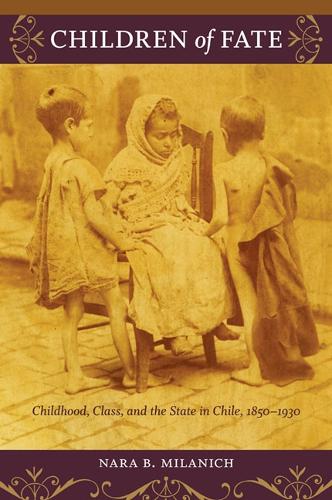
Книга Children of Fate: Childhood, Class, and the State in Chile, 1850–1930
Discusses the history of child-rearing conditions and practices in late 19th and early 20th century Chile
In modern Latin America, profound social inequalities have persisted despite the promise of equality. Nara B. Milanich argues that social and legal practices surrounding family and kinship have helped produce and sustain these inequalities. Tracing families both elite and plebeian in late-nineteenth- and early-twentieth-century Chile, she focuses on a group largely invisible in Latin American historiography: children. The concept of family constituted a crucial dimension of an individual’s identity and status, but also denoted a privileged set of gendered and generational dependencies that not all people could claim. Children of Fate explores such themes as paternity, illegitimacy, kinship, and child circulation over the course of eighty years of Chile’s modern history to illuminate the ways family practices and ideologies powerfully shaped the lives of individuals as well as broader social structures.
Milanich pays particular attention to family law, arguing that liberal legal reforms wrought in the 1850s, which left the paternity of illegitimate children purposely unrecorded, reinforced not only patriarchal power but also hierarchies of class. Through vivid stories culled from judicial and notarial sources and from a cache of documents found in the closet of a Santiago orphanage, she reveals how law and bureaucracy helped create an anonymous underclass bereft of kin entitlements, dependent on the charity of others, and marginalized from public bureaucracies. Milanich also challenges the recent scholarly emphasis on state formation by highlighting the enduring importance of private, informal, and extralegal relations of power within and across households. Children of Fate demonstrates how the study of children can illuminate the social organization of gender and class, liberalism, law, and state power in modern Latin America.
"“Children of Fate is a remarkable historical account of the intertwining of family law, vernacular kinship practices, and class in late-19th-century Chile.”" - PoLAR
"“In Children of Fate, Milanich provides a richly textured study of childhood
and filiation in late nineteenth- and early twentieth-century Chile that culls important stories from new archives and analyzes the liberal state’s role in ‘generating kinlessness.’. . . The resulting study provides an insightful and often heart-rending account of the vicissitudes of children without parents—and adults without kin—in late nineteenth- and early twentieth-century Chile.”
" - Journal of Interdisciplinary History
"“In this beautifully written and well-crafted book, Nara B. Milanich convincingly argues that the family served as the nexus for class formation in late nineteenth and early twentieth century Chile. . . . [T]his study makes a major contribution to the burgeoning historiography of children in Latin America. In addition, Children of Fate should become required reading for students of class and state formation beyond Latin America.”" - Labour/Le Travail
"Through a study of deeply rooted sociocultural structures . . . , Children of Fate seeks to understand how inequality has been produced, reproduced and perpetuated over time, resisting the cycles of economic growth and public policies that would supposedly end it. . . . Children of Fate stands out . . . for the importance of its subject and for contributing to a necessary and urgent discussion in Chilean society, reminding us that reducing social inequality cannot be left to economic growth but requires a cultural change that . . . even today has yet to materialize."
- A Contracorriente