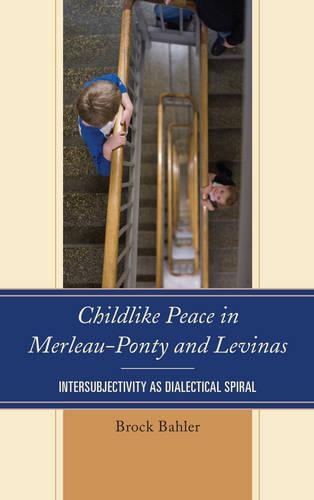
Книга Childlike Peace in Merleau-Ponty and Levinas: Intersubjectivity as Dialectical Spiral
By examining the parent-child relationship, Childlike Peace in Merleau-Ponty and Levinas argues that the primordial structure of our personal encounters with others should be understood as a dialectical spiral. Drawing on the work of twentieth-century philosophers Maurice Merleau-Ponty and Emmanuel Levinas, and informed by recent advances in cognitive neuroscience and child development, Brock Bahler develops a phenomenological description of the parent-child relationship in order to articulate an account of intersubjectivity that is fundamentally ethically oriented, dialogical, and mutually dynamic. This dialectical spiral—in contrast to Cartesian tradition of the subject and the Hegelian master-slave dialectic—suggests that our lives are equiprimordially interwoven with both the richness of mutual engagement and the responsibility to be for-the-other. The parent-child relationship provides the basis for a theoretical account of intersubjectivity that is marked by a creative interaction between self and other that cannot be reduced to an economic exchange, a totalizing structure, or a unilateral asymmetrical responsibility. In conversation with the philosophical thought of Merleau-Ponty, Levinas, Hegel, Sartre, and Freud, as well as recent research in cognitive neuroscience and child development, this work will be of interest for those working in the fields of continental philosophy, embodied cognition, philosophy of childhood, psychoanalysis, psychology, philosophy for children (P4C), and education.
"Bahler (religious studies, Univ. of Pittsburgh) describes subjectivity without what he takes to be the errors of the philosophical tradition. The philosophical tradition tends to treat subjectivity as a property of an ego separated from others. This private, subjective world connects with others only through self-interest or shame. Traditional accounts of subjectivity are pessimistic about human relations. Bahler presents an alternative account that is based on the writings of French philosophers Emmanuel Levinas and Maurice Merleau-Ponty. Usually these two thinkers are considered to be in sharp disagreement, but Bahler combines their insights by examining their views on the parent-child relation. The parent-child relation is resistant to traditional analysis and reveals a relationship that is best understood as ethical as opposed to interest driven. This leads to a more optimistic reading of human relations. Bahler explores some of the political and social consequences of this view of subjectivity. Though both Levinas and Merleau-Ponty are difficult writers, Bahler's presentation is ...clear and accessible. This is a book for those interested in philosophy and/or child psychology. Summing Up: Recommended. Upper-division undergraduates and above." - CHOICE