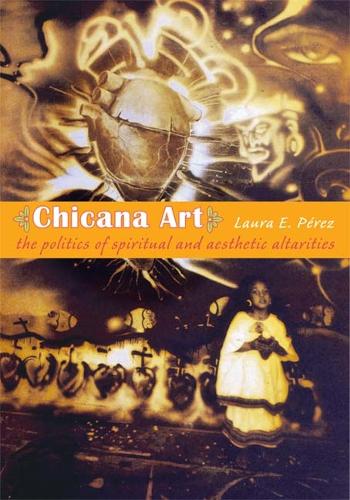
Книга Chicana Art: The Politics of Spiritual and Aesthetic Altarities
The first full-length survey of contemporary Chicana artists - lavishly illustrated
In Alma Lopez’s digital print Lupe & Sirena in Love (1999), two icons—the Virgin of Guadalupe and the mermaid Sirena, who often appears on Mexican lottery cards—embrace one another, symbolically claiming a place for same-sex desire within Mexican and Chicano/a religious and popular cultures. Ester Hernandez’s 1976 etching Libertad/Liberty depicts a female artist chiseling away at the Statue of Liberty, freeing from within it a regal Mayan woman and, in the process, creating a culturally composite Lady Liberty descended from indigenous and mixed bloodlines. In her painting Coyolxauhqui Last Seen in East Oakland (1993), Irene Perez reimagines as whole the body of the Aztec warrior goddess dismembered in myth. These pieces are part of the dynamic body of work presented in this pioneering, lavishly illustrated study, the first book primarily focused on Chicana visual arts.
Creating an invaluable archive, Laura E. Pérez examines the work of more than forty Chicana artists across a variety of media including painting, printmaking, sculpture, performance, photography, film and video, comics, sound recording, interactive CD-ROM, altars and other installation forms, and fiction, poetry, and plays. While key works from the 1960s and 1970s are discussed, most of the pieces considered were produced between 1985 and 2001. Providing a rich interpretive framework, Pérez describes how Chicana artists invoke a culturally hybrid spirituality to challenge racism, bigotry, patriarchy, and homophobia. They make use of, and often radically rework, pre-Columbian Mesoamerican and other non-Western notions of art and art-making, and they struggle to create liberating versions of familiar iconography such as the Virgin of Guadalupe and the Sacred Heart. Filled with representations of spirituality and allusions to non-Western visual and cultural traditions, the work of these Chicana artists is a vital contribution to a more inclusive canon of American arts.
"“Chicana Art is the first book of its kind that preserves a long history of outspoken Latinas using their talents to change family traditions. With their richly colorful artwork, these Chicanas successfully show the Western world who they are and why they aren’t just another Spanish-speaking minority. Perez not only examines the different stories behind many Chicana’s religious installations, but she encourages her audience to empower themselves by altering their self image and embrace the future that awaits them.”" - Feminist Review blog
"“Pérez offers a rich analysis of a vast array of artistic works. . . . Pérez’s arguments are theoretically sound and always consistent with the organizing category of politicized spirituality. . . . Pérez’s notion of the politics of the spiritual as generative of tangible political and social effects is a critical contribution to the epistemological frameworks that inform Chicana/o studies and extends further to enrich this category’s management within art history, literary, and American studies.”" - Aztlán
"“The first book-length study of Chicana art, this long-anticipated volume surpasses expectation in breadth, depth, and presentation and begins to fill a noticeable gap in feminist scholarship. We applaud Duke University Press for having done an exceptional job in the production of this book. Beautifully designed, it is printed on heavy paper with high quality graphics and carefully chosen fonts. This high production value pays respect to the quality, depth, and diversity of the Chicana arts movement, which—as Pérez argues—encompasses a rich array of literature, essays, film, and fine arts including prints, silkscreen, painting, photography, murals, textiles, mixed media, digital art, conceptual art, and performance art.”" - Signs