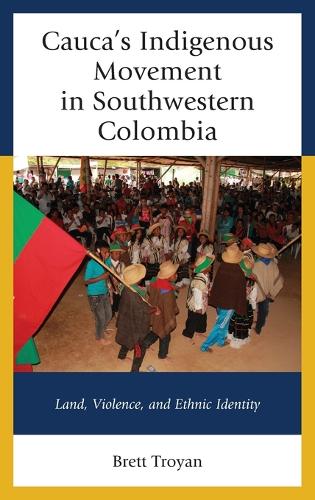
Книга Cauca's Indigenous Movement in Southwestern Colombia: Land, Violence, and Ethnic Identity
Cauca's Indigenous Movement in Southwestern Colombia: Land, Violence, and Ethnic Identity provides a vivid account of how the indigenous communities of Cauca in southwestern Colombia engaged with the Colombian central state. Troyan begins with the question of how 3.4 percent of the Colombian population obtained legal rights to close to a quarter of the national territory. Her in-depth study of the correspondence between the central state and indigenous communities of Cauca reveals that the nation state played a key role in the legitimization of land claims based on ethnic identity. Starting with the indigenous movement led by Manuel Quintín Lame in 1914, this book shows how, in contrast to the local authorities of Cauca, the central state adopted a more sympathetic albeit contradictory approach to indigenous communities’ grievances throughout the twentieth century. Land, Violence, and Cauca's Indigenous Movement in Southwestern Colombia presents an examination of state initiatives in the 1930s, 1950s, 1960s, and 1970s toward indigenous communities in Cauca, which sheds light on the political and social construction of Colombian indigenous identity. Troyan also reveals how violence and the representation of violence shaped the conversations between the central state and indigenous communities of Cauca; the central state’s inability to exert a monopoly on violence, Troyan argues, places indigenous communities and their leaders in jeopardy despite the discursive legitimization of land claims based on ethnic identity.
"Brett Troyan has produced a thoughtful and persuasively argued history of Cauca and of the emergence of a movement for indigenous self-determination in that Colombian department. The book provides a carefully detailed political history of what became one of the Americas’ important indigenous-led movements. . . .[S]pecialists will be grateful to Troyan for the seriousness with which she proceeds. Historians, in particular, are likely to feel that this is that rare book that would have been improved by being longer. . . .Troyan’s research will be a necessary starting point for those hoping to understand the history of indigenous politics. New generations of scholars will benefit from her footnotes…and they will especially appreciate her thorough bibliography. . . .Colombianists and Latin Americanists in general are in debt to the step forward offered by Troyan’s book." - Hispanic American Historical Review