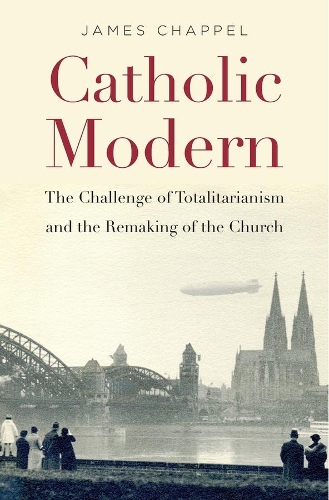
Книга Catholic Modern: The Challenge of Totalitarianism and the Remaking of the Church
In 1900 the Catholic Church stood staunchly against human rights, religious freedom, and the secular state. According to the Catholic view, modern concepts like these, unleashed by the French Revolution, had been a disaster. Yet by the 1960s, those positions were reversed. How did this happen? Why, and when, did the world’s largest religious organization become modern?
James Chappel finds an answer in the shattering experiences of the 1930s. Faced with the rise of Nazism and Communism, European Catholics scrambled to rethink their Church and their faith. Simple opposition to modernity was no longer an option. The question was how to be modern. These were life and death questions, as Catholics struggled to keep Church doors open without compromising their core values. Although many Catholics collaborated with fascism, a few collaborated with Communists in the Resistance. Both strategies required novel approaches to race, sex, the family, the economy, and the state.
Catholic Modern tells the story of how these radical ideas emerged in the 1930s and exercised enormous influence after World War II. Most remarkably, a group of modern Catholics planned and led a new political movement called Christian Democracy, which transformed European culture, social policy, and integration. Others emerged as left-wing dissidents, while yet others began to organize around issues of abortion and gay marriage. Catholics had come to accept modernity, but they still disagreed over its proper form. The debates on this question have shaped Europe’s recent past—and will shape its future.
"Fascinating…Chappel’s is a complex intellectual history, focusing not on popes and bishops, but on the lay individuals and movements of ideas that drove this sea change…[He] deftly survey[s] the intellectual evolution of Catholic thought throughout the 20th century." - Los Angeles Review of Books
"Deeply researched and beautifully written…[An] excellent book…Chappel’s history shows how profoundly Catholicism can be transformed over time." - The Nation
"Catholic Modern is an endlessly fascinating analysis of Catholic social thought in turbulent times, which I imagine we will be turning to for years to come. Essential reading." - Catholic Herald
"Highly creative, massively researched, and eye-opening…[A] fresh recasting of history." - Commonweal
"Chappel has taken one facet of the Catholic modern and explored it with exemplary scholarship and originality." - Times Higher Education
"Authoritative…It sets out to explain how, when, and why the Catholic Church became modern." - Boston Review
"A heady look at how the church remade itself at a time of social and political upheaval." - America
"Chappel has historicized the dueling forms of Catholic modern at the heart of present polarization in the church…If you are a Catholic theologian working with twentieth-century European or Latin American figures, you need to read this book." - Horizons
"An incisive account of how Catholics became (and not were) modern…A magnificent book by a promising author and scholar. A must-read for all who have an interest in the manifold ways in which faith and ideology have forged the minds and lives of so many during the twentieth century." - Social History
"Chappel skillfully explores how, why, and when the Catholic church became modern." - Publishers Weekly
"Groundbreaking…This bare summary does not do justice to the sophistication and breadth of Chappel’s book. It is vital reading for anyone interested in the [Roman Catholic] Church’s engagement with politics in the 20th century." - Church Times
"A key contribution to understanding the relationship between Catholicism and political modernity as experienced particularly in the decades before and immediately after the Second World War…An immensely useful assessment of a critical period for the formation of Catholic attitudes and ideas that still resonate in today’s church and secular politics." - Theological Studies
"A persuasive account, from the perspective of intellectual history, of how ultramontane Catholicism swiftly but gradually discarded its ingrained antimodern stance…Highly readable and many readers of different stripes will find it of great interest. Chappel’s contribution to the history of late modern Catholicism will certainly garner much richly deserved attention." - Journal of Modern History