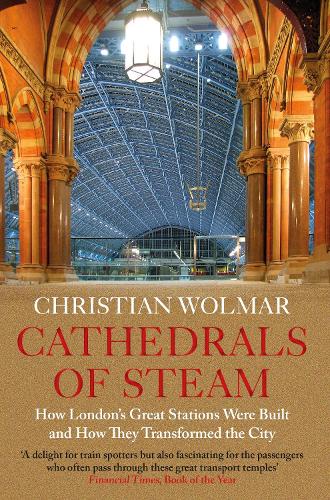
Книга Cathedrals of Steam: How London’s Great Stations Were Built – And How They Transformed the City
'Fascinating' 'Books of the Year', Financial Times
'London's twelve great rail termini are the epic survivors of the Victorian age... Wolmar brings them to life with the knowledge of an expert and the panache of a connoisseur.' Simon Jenkins
'A wonderful tour, full of vivid incident and surprising detail.' Simon Bradley
London hosts twelve major railway stations, more than any other city in the world. They range from the grand and palatial, such as King's Cross and Paddington, to the modest and lesser known, such as Fenchurch Street and Cannon Street. These monuments to the age of the train are the hub of London's transport system and their development, decline and recent renewal have determined the history of the capital in many ways.
Built between 1836 and 1899 by competing private train companies seeking to outdo one another, the construction of these terminuses caused tremendous upheaval and had a widespread impact on their local surroundings. What were once called 'slums' were demolished, green spaces and cemeteries were concreted over, and vast marshalling yards, engine sheds and carriage depots sprung up in their place.
In a compelling and dramatic narrative, Christian Wolmar traces the development of these magnificent cathedrals of steam, provides unique insights into their history, with many entertaining anecdotes, and celebrates the recent transformation of several of these stations into wonderful blends of the old and the new.
"Wolmar's history will delight train spotters but is also fascinating for the passengers who often pass through these great transport temples without a second thought." - 'Books of the Year', Financial Times
"Lively... Wolmar builds a compelling narrative that celebrates these industrial wonders - and teases at how much better spent some of that Victorian money might have been." - The Times
"A terrific book for anyone interested, not just in London's stations, but in the development of the railway since the capital's first terminus, London Bridge, opened in 1836." - ASLEF Journal
"Excellent... In a skilful fusion of practicalities and aesthetics, the author captures the essence of our experience of grand stations and also reminds us to look when we pass through or, more commonly, linger impatiently while we wait for our train's platform to be called." - New Criterion
"A fascinating story of Victorian capitalist free-for-all and competition behind the development of mainline stations." - Camden New Journal
"London's railway termini are a monument to Victorian taste and ingenuity, now revived and re-imagined for the 21st century. Christian Wolmar's Cathedrals of Steam is their story and London's, vividly and intimately intertwined.'" - Country & Town House