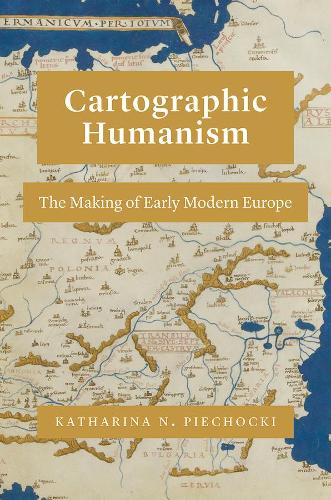
Книга Cartographic Humanism: The Making of Early Modern Europe
What is "Europe," and when did it come to be? In the Renaissance, the term "Europe" circulated widely. But as Katharina N. Piechocki argues in this compelling book, the continent itself was only in the making in the fifteenth and sixteenth centuries. Cartographic Humanism sheds new light on how humanists negotiated and defined Europe's boundaries at a momentous shift in the continent's formation: when a new imagining of Europe was driven by the rise of cartography. As Piechocki shows, this tool of geography, philosophy, and philology was used not only to represent but, more importantly, also to shape and promote an image of Europe quite unparalleled in previous centuries. Engaging with poets, historians, and mapmakers, Piechocki resists an easy categorization of the continent, scrutinizing Europe as an unexamined category that demands a much more careful and nuanced investigation than scholars of early modernity have hitherto undertaken. Unprecedented in its geographic scope, Cartographic Humanism is the first book to chart new itineraries across Europe as it brings France, Germany, Italy, Poland, and Portugal into a lively, interdisciplinary dialogue.
"Piechocki is conceptually rigorous, she reads many languages and her research is impeccable. She is a careful critic but also a deeply imaginative historian. This is a contribution to the 'darker side' of cartography and the Renaissance, emphasizing the relationship between writing and scholarship and the exercise of power and exploitation, but its analysis never departs from the measured and reflective." - Times Higher Education
"This is an ambitious book which convincingly achieves its goals. It makes great claims for Humanism, the Renaissance and especially for cartography in establishing a new idea of Europe, and presents detailed evidence for those claims in closely argued and highly detailed case studies." - European History Quarterly
"[A] timely book...well worth a read." - Journal of Historical Geography
"Katharina Piechocki’s Cartographic Humanism is an indispensable book for scholars in many disciplines who think or write about cartography, Europeanness, or [the] Renaissance." - The Polish Review
"Katharina N. Piechocki’s elegant and incisive new work on how an assemblage of sixteenth-century humanists took the classical designation of 'Europa' and transformed it from a loosely defined appendage to Asia’s landmass into a more sharply delineated territory with political and metaphysical overtones." - Isis
"How did Europe emerge through pictorial maps, and what did early Renaissance maps and cartopoetics have to do with that emergence? Cartographic Humanism is an intertextual study of the history of cartography that looks at transnational spaces of fantasy and exploration, knowledge and emotion, and symbolic places and claimed discovery. . . .In this effervescent book of literary criticism and the map, there is much creative ground to be gained." - Austrian History Yearbook
"Piechocki's study is a complex contribution to the study of the understanding of Europe in the Renaissance... Although this is never explicitly mentioned by the author herself, this book can also be understood as a serious examination of the reception of Ptolemaic geography in the 15th and 16th centuries... Piechocki's impressive contribution remeasures the broad field of early modern European research." - H-Soz-Kult (translated from German)