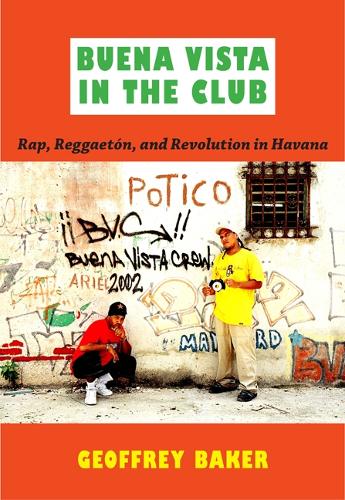
Книга Buena Vista in the Club: Rap, Reggaetón, and Revolution in Havana
Details the trajectory of the Havana hip hop scene from the late 1980s to the present and analyzes its partial eclipse by reggaeton
In Buena Vista in the Club, Geoffrey Baker traces the trajectory of the Havana hip hop scene from the late 1980s to the present and analyzes its partial eclipse by reggaetón. While Cuban officials initially rejected rap as “the music of the enemy,” leading figures in the hip hop scene soon convinced certain cultural institutions to accept and then promote rap as part of Cuba’s national culture. Culminating in the creation of the state-run Cuban Rap Agency, this process of “nationalization” drew on the shared ideological roots of hip hop and the Cuban nation and the historical connections between Cubans and African Americans. At the same time, young Havana rappers used hip hop, the music of urban inequality par excellence, to critique the rapid changes occurring in Havana since the early 1990s, when the Soviet Union fell, its subsidy of Cuba ceased, and a tourism-based economy emerged. Baker considers the explosion of reggaetón in the early 2000s as a reflection of the “new materialism” that accompanied the influx of foreign consumer goods and cultural priorities into “sociocapitalist” Havana. Exploring the transnational dimensions of Cuba’s urban music, he examines how foreigners supported and documented Havana’s growing hip hop scene starting in the late 1990s and represented it in print and on film and CD. He argues that the discursive framing of Cuban rap played a crucial part in its success.
"“Buena Vista in the Club is an essential addition to the growing scholarship on global hip hop. Baker adds to this scholarship in two significant ways. First, unlike his predecessors, he refuses to isolate the study of rap from reggaetón, preferring instead to analyze the interplay between the two genres. Second, he takes reflexivity to a new level by revealing the ways in which the works of foreign journalists and scholars have shaped the representation of Cuban rap and facilitated its success.”" - Labour/Le Travail
"“Buena Vista in the Club is an excellent contribution to the fields of Cuban cultural studies, hip hop studies, and world music studies. Baker opens up new areas for further inquiry into the role of the foreign scholar, bodily discourse within popular forms, and close readings of Cuba’s principal hip hop group today, Los Aldeanos.”
" - The Latin Americanist
"“Buena Vista is Baker’s second book on music in Latin America and is a valuable contribution to Duke University Press’s Refiguring American Music series. This series, edited by Ronald Radano and Josh Kun, questions and confronts the dominant narratives framing the study of American music. In meeting the broad aims of the series, Baker throws a wide net that encompasses hip hop and reggaetón, as well as frameworks of race, politics, economies, globalisation and urban studies. It speaks greatly of Baker that this book maintains a sense of immediacy and detail as these broad strands are woven together. Baker’s contribution will undoubtedly lead to further debate on Cuban hip hop. . . .”" - Popular Music
"“[A] lively, personal examination of Havana’s street music, dance, and politics. . . . In tracing the history of rap and reggaetón, Baker makes a major contribution to the understanding of Cuban popular music and the global commercial success of rap music. Highly recommended.”" - Choice
"“In Buena Vista in the Club, University of London Music Professor Geoffrey Baker examines the rise and fall of Cuban hip-hop.... This retrospective looks at the evolution of the Cuban hip-hop industry and how it has affected Cuban society, politics, and Havana’s relationship with the New York music industry.”" - NACLA Report on the Americas
"“The text is both extremely readable, for its accessible language, and academically rigorous, for the bibliographic references…. [T]he book is a thorough study of the politics of style in hip hop and reggaetón in Cuba. Baker demonstrates a deep knowledge of the discourses surrounding the representation of the Cuban rap scene produced by academia and the media.”" - International Journal of Cuban Studies