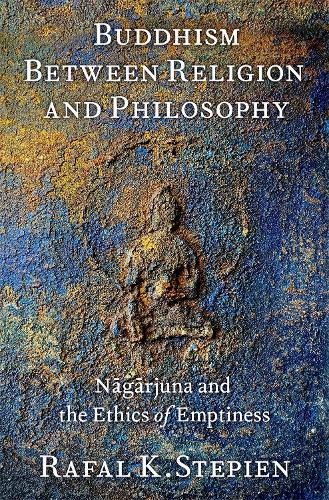
Книга Buddhism Between Religion and Philosophy: Nāgārjuna and the Ethics of Emptiness
Nāgārjuna (c. 150-250), founder of the Madhyamaka or Middle Way school of Buddhist philosophy and the most influential of all Buddhist thinkers aside from the Buddha himself, concludes his masterpiece, Fundamental Verses on the Middle Way, with these baffling verses: For the abandonment of all views He taught the true teaching By means of compassion I salute him, Gautama But how could anyone possibly abandon all views? In Buddhism between Religion and Philosophy, Rafal K. Stepien shows not only how Nāgārjuna's radical teaching of no-view or “abelief” makes sense within his Buddhist philosophy, but also how it stands at the summit of his religious mission to care for all living beings. Rather than treating any one aspect of Nāgārjuna's ideas in isolation, here his metaphysics, epistemology, and ethics emerge as a single coherent and convincing philosophical-religious system of thought and practice. Grounded in meticulous study of original texts from classical India and China but innovating on the theories and methods underpinning contemporary scholarship East and West, this study shows how profoundly important voices from the diverse religious and philosophical traditions of the world have until now been diminished, distorted, and silenced. In opening up truly global horizons of existing and co-existing in the world, this work challenges the very ways in which we think about religion and philosophy.
"Stepien presents a detailed, clearly argued critique of much of the contemporary Western intellectual engagement with Nāgārjuna and describes how Nāgārjuna's Madhyamaka can be understood as the source of an approach that is simultaneously religious, philosophical, and ethical in nature. Scholars working on the historical, religious, and philosophical aspects of Nāgārjuna's works have much to gain from engaging closely with Stepien's arguments." - Jan Westerhoff, Professor of Buddhist Philosophy, University of Oxford
"Nāgārjuna's Fundamental Verses on the Middle Way is often read as a purely metaphysical exploration of emptiness, or, if more than this, purely soteriological. Rafal Stepien argues that this is a misreading-that Nāgārjuna's project is not only metaphysical and soteriological, but also ethical, adding nuance to our understanding of the Buddhist ethical project and of Madhyamaka philosophy." - Jay Garfield, Author of Buddhist Ethics: A Philosophical Exploration
"Stepien extricates Nāgārjuna from narrow philosophical doldrums and, impressively, foregrounds the ethical significance of this incomparable thinker. Students of Buddhist philosophy will find much benefit in such a reading." - Jonathan C. Gold, Author of Paving the Great Way: Vasubandhu's Unifying Buddhist Philosophy
"Legend has it that Nāgārjuna descended to the bottom of the ocean in order to bring back the founding texts of his provocative tradition. Rafal Stepien has descended into the restless ocean of contemporary interpretations rising around Nāgārjuna's works and returned with provocations of his own, asking whether our ways of making sense of Nāgārjuna do justice to his texts and the textures of his thought. Stepien conjures for us one more Nāgārjuna, one whose arguments deserve engagement, whose words just might change your mind." - Sonam Kachru, Author of Other Lives: Mind and World in Indian Buddhism.