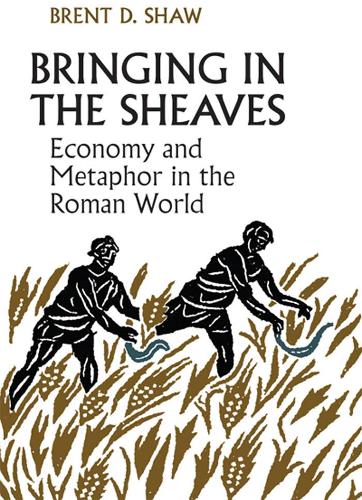
Книга Bringing in the Sheaves: Economy and Metaphor in the Roman World
"I have really enjoyed reading Bringing in the Sheaves. Both the subject and its handling are outstandingly original. Brent D. Shaw pulls out a single vital aspect of ancient agriculture and shows how it reverberates through society and culture. Bringing to bear a huge range of comparative illumination, from the New Testament to the Prairies in the age of mechanization, he shows that the paroxysm of human effort involved every year in the cereal harvest has a historical centrality that goes far beyond understanding life on the land. Along the way, he deploys his new insights to solve some of the conundrums of social unrest in late Roman Africa. But with its vast historical scope and its ground-breaking melding of cultural metaphor with social and economic data, Bringing in the Sheaves will have a place of its own in debate in large-scale, long-period, comparative and interdisciplinary history-writing. -- Nicholas Purcell, Faculty of Classics, Oxford University "Bringing in the Sheaves provides a persuasive case for the centrality of the harvest to the life of the Roman Empire and a broad, panoramic discussion of the harvest's role in this society. Throughout the book, Brent D. Shaw demonstrates the depth and breadth of his learning about the ancient world, drawing expertly on an amazing range of comparative evidence in such a way that few can match. His book is ground-breaking, highly original, and a significant contribution to scholarship." -- Dennis Kehoe, Department of Classics, Tulane University
The annual harvesting of cereal crops was one of the most important economic tasks in the Roman Empire. Not only was it urgent and critical for the survival of state and society, it mobilized huge numbers of men and women every year from across the whole face of the Mediterranean. In Bringing in the Sheaves, Brent D. Shaw investigates the ways in which human labour interacted with the instruments of harvesting, what part the workers and their tools had in the whole economy, and how the work itself was organized.
Both collective and individual aspects of the story are investigated, centred on the life-story of a single reaper whose work in the wheat fields of North Africa is documented in his funerary epitaph. The narrative then proceeds to an analysis of the ways in which this cyclical human behaviour formed and influenced modes of thinking about matters beyond the harvest. The work features an edition of the reaper inscription, and a commentary on it. It is also lavishly illustrated to demonstrate the important iconic and pictorial dimensions of the story.
"‘Fascinating study of harvest and harvesting in the Roman world…Not only is this the most wide-ranging study of the harvest in antiquity that I am aware of, it should be read by all who are interested in the link between life and thought in the Roman world.’" - American Historical Review, vol 119:02:2014
"
‘How wonderful to read a book written by a true scholar, which brims with humor, critique, insight, and expansiveness… Highly recommended.’
" - Choice Magazine vol 51:01:2013"
‘The volume is incredibly rich in content with almost one hundred illustrations in black and white, more than a thousand endnotes, and thirty-five pages of bibliography… Shaw’s book advances our understanding of agricultural society and is an important contribution to the study of late antiquity.’
" - The Historian vol 77:01:2015