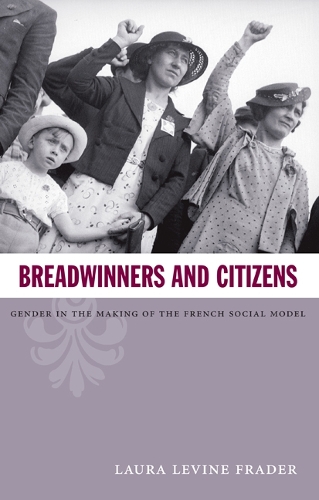
Книга Breadwinners and Citizens: Gender in the Making of the French Social Model
Contradictions in the French welfare state and its self-image as an egalitarian system
Laura Levine Frader’s synthesis of labor history and gender history brings to the fore failures in realizing the French social model of equality for all citizens. Challenging previous scholarship, she argues that the male breadwinner ideal was stronger in France in the interwar years than scholars have typically recognized, and that it had negative consequences for women’s claims to the full benefits of citizenship. She describes how ideas about masculinity, femininity, family, and work affected post–World War I reconstruction, policies designed to address France’s postwar population deficit, and efforts to redefine citizenship in the 1920s and 1930s. She demonstrates that gender divisions and the male breadwinner ideal were reaffirmed through the policies and practices of labor, management, and government. The social model that France implemented in the 1920s and 1930s incorporated fundamental social inequalities.
Frader’s analysis moves between the everyday lives of ordinary working women and men and the actions of national policymakers, political parties, and political movements, including feminists, pro-natalists, and trade unionists. In the years following World War I, the many women and an increasing number of immigrant men in the labor force competed for employment and pay. Family policy was used not only to encourage reproduction but also to regulate wages and the size of the workforce. Policies to promote married women’s and immigrants’ departure from the labor force were more common when jobs were scarce, as they were during the Depression. Frader contends that gender and ethnicity exerted a powerful and unacknowledged influence on French social policy during the Depression era and for decades afterward.
"“Breadwinners and Citizens, Laura Frader’s new book, is a major scholarly contribution to histories of gender, work and citizenship during the 1920s and 1930s. . . . Laura Frader has written an eminently readable book that is also impeccably researched and footnoted.”" - H-France, H-Net Reviews
"“By marshalling great detail backed by powerful examples to back her case that the male breadwinner ideal was stronger in interwar France than most scholars have appreciated, Frader has done an important service to scholars of both gender and labor. For the scholar entering into this field of study for the first time, Breadwinners and Citizens will be of great use. . . . [T]his is an important book on a too-long underanalyzed subject.”" - History: Reviews of New Books
"“Laura Levine Frader has written a deeply researched study of the gender transformations that occurred in interwar France as laborers struggled to meet new production demands with a diminished postwar population. . . . While Frader is certainly not the first to study twentieth-century French labor through the lens of gender, the detail she brings to Breadwinners and Citizen makes it a masterwork of French history.”" - Women's Studies Quarterly
"“This book skillfully blends standard economic and labor history sources and methods…with a critical cultural studies approach to French assumptions about gender, family, and population. . . . From now on, French gender, labor, and social historians will have to take Frader’s subtle reading of the gendering of the labor market into account.”" - American Historical Review