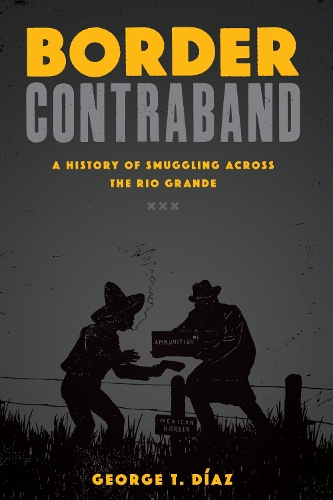
Книга Border Contraband: A History of Smuggling across the Rio Grande
"Far from Washington, DC, and Mexico City, borderlanders smuggled licit and illicit products. While bureaucrats attempted to control the smugglers, they were celebrated in popular culture, and some rose to be pillars of their communities. In a well-researched, accessible, and engaging study, George Diaz documents the ebb and flow of an array of commodities and the lives of those who subverted federal laws, whether for profit or survival, on both sides of the border." -- Elaine Carey, St. John's University, author of Women Drug Traffickers: Mules, Bosses, and Organized Crime "This book addresses a major border subject that has long been neglected by scholars, a neglect that is largely explained by the difficulty of researching an illegal activity such as smuggling. George Diaz has done a commendable job of unearthing source materials both in the United States and Mexico that shed light on the subject. The book is well written, interesting, and informative, and is well illustrated by many examples of individual smugglers and contrabandista activities... It will be very useful to scholars, students, and general readers." -- Oscar J. Martinez, Regents' Professor of History, University of Arizona "Border Contraband finds that borderlanders in the Laredo-Nuevo Laredo area accepted everyday illegal smuggling when the practice benefited bargain-conscious consumers. At the same time, however, community values discountenanced the smuggling of alcohol and guns, for such trafficking attracted organized crime. To document this understudied phenomenon, George Diaz draws on solid primary sources deposited in some of the richest archives in Mexico and the United States. Kudos to this first work by an up-and-coming young historian." -- Arnoldo De Leon, Angelo State University "Border Contraband: A History of Smuggling across the Rio Grande provides one the first full-length historical monographs that historicizes the changing practices and perceptions of everyday smuggling between Mexico and the United States over the course of a century. In this fascinating analysis of 'common smuggling' between Texas and Northeastern Mexico, historian George T. Diaz illustrates how these two states attempted to control and regulate 'illicit trade' between these border locales, and how everyday people subverted state and federal efforts to impinge upon what many considered to be part and parcel of a broader 'moral economy.' Those looking to contextualize the genealogy of smuggling along the U.S.-Mexico border would be wise to consider pondering these questions with a reading of Border Contraband." -- Jose Angel Hernandez, Associate Professor of History, University of Houston "Here's the book I've been waiting for: a well-researched history of the clandestine side of U.S.-Mexico trade relations. Today's heated debates about an out-of-control border too often suffer from historical amnesia. Diaz has given us a much-needed historical corrective and reality check, reminding us that the border has never actually been under control." -- Peter Andreas, author of Smuggler Nation: How Illicit Trade Made America
Present-day smuggling across the U.S.-Mexico border is a professional, often violent, criminal activity. However, it is only the latest chapter in a history of illicit business dealings that stretches back to 1848, when attempts by Mexico and the United States to tax commerce across the Rio Grande upset local trade and caused popular resentment. Rather than acquiesce to what they regarded as arbitrary trade regulations, borderlanders continued to cross goods and accepted many forms of smuggling as just. In Border Contraband, George T. Díaz provides the first history of the common, yet little studied, practice of smuggling across the U.S.-Mexico border. In Part I, he examines the period between 1848 and 1910, when the United States’ and Mexico’s trade concerns focused on tariff collection and on borderlanders’ attempts to avoid paying tariffs by smuggling. Part II begins with the onset of the Mexican Revolution in 1910, when national customs and other security forces on the border shifted their emphasis to the interdiction of prohibited items (particularly guns and drugs) that threatened the state. Díaz’s pioneering research explains how greater restrictions have transformed smuggling from a low-level mundane activity, widely accepted and still routinely practiced, into a highly profitable professional criminal enterprise.