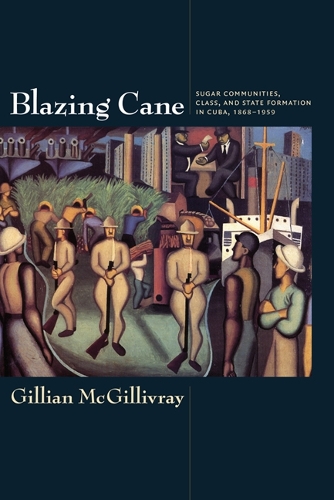
Книга Blazing Cane: Sugar Communities, Class, and State Formation in Cuba, 1868–1959
Discusses the national and transnational implications of local developments in two sugar mill communities in Cuba
Sugar was Cuba’s principal export from the late eighteenth century throughout much of the twentieth, and during that time, the majority of the island’s population depended on sugar production for its livelihood. In Blazing Cane, Gillian McGillivray examines the development of social classes linked to sugar production, and their contribution to the formation and transformation of the state, from the first Cuban Revolution for Independence in 1868 through the Cuban Revolution of 1959. She describes how cane burning became a powerful way for farmers, workers, and revolutionaries to commit sabotage, take control of the harvest season, improve working conditions, protest political repression, attack colonialism and imperialism, nationalize sugarmills, and, ultimately, acquire greater political and economic power.
Focusing on sugar communities in eastern and central Cuba, McGillivray recounts how farmers and workers pushed the Cuban government to move from exclusive to inclusive politics and back again. The revolutionary caudillo networks that formed between 1895 and 1898, the farmer alliances that coalesced in the 1920s, and the working-class groups of the 1930s affected both day-to-day local politics and larger state-building efforts. Not limiting her analysis to the island, McGillivray shows that twentieth-century Cuban history reflected broader trends in the Western Hemisphere, from modernity to popular nationalism to Cold War repression.
"“Blazing Cane is in the finest tradition of Cuban rural history, while at the same time clearing a new interpretative path. . . . Blazing Cane is well suited for a general audience. The section on the Chaparra sugar mill includes 14 photographs from the mill archives, which are of such high quality that one can almost taste the sugar being processed.”
" - European Review of Latin American and Caribbean Studies
"“Lucidly written, sophisticated, marvelously nuanced, and meticulously researched. . . . This is simply superb history. Summing Up: Essential. All levels/libraries.”" - Choice
"“McGillivray’s insistence on embedding the history of the two sugar communities within the broad sweep of Cuba’s historical development makes this book especially attractive to teachers as well as researchers. Indeed, Blazing Cane could profitably be used as the core text for courses dealing with Cuban history in the one hundred years preceding the 1959 Revolution, and as a model for how to study the interactions between local, regional, national, and transnational forces.”" - Hispanic American Historical Review
"“McGillivray’s research has been terrific. . . . She has wisely combined archival documents, a considerable number of newspaper articles, and interviews, broadening her analysis and cementing her conclusions. Overall, Blazing Cane constitutes a courageous take on this aspect of the history of twentieth-century Cuba. . .”" - A Contracorriente
"“This book offers a new understanding of Cuba’s sugar politics. It will prove essential to anyone interested in pre-1959 Cuban history or in the relationship of the middle class to state formation in Latin America.”" - American Historical Review
"“With Blazing Cane, McGillivray has given Cubanists — and Latin Americanists in general — a treat: a book both accessible to undergraduates and meaty enough for a graduate class, one that offers convincing answers to many questions and at the same time suggests new avenues of research. In so doing, Blazing Cane provides a fresh vision of Cuba in the twentieth century, tying the nation into larger regional trends rather than separating it from them. In the end, like the cane fires that flare up throughout the book to signal moments of change, Blazing Cane may itself be a marker, lighting a new path in the study of Cuban history.”" - Labor