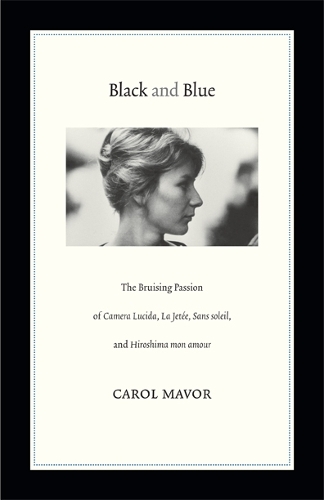
Книга Black and Blue: The Bruising Passion of Camera Lucida, La Jete, Sans soleil, and Hiroshima mon amour
Exquisite, image-filled ruminations on efforts to capture fleeting moments and to comprehend the incomprehensible
Audacious and genre-defying, Black and Blue is steeped in melancholy, in the feeling of being blue, or, rather, black and blue, with all the literality of bruised flesh. Roland Barthes and Marcel Proust are inspirations for and subjects of Carol Mavor's exquisite, image-filled rumination on efforts to capture fleeting moments and to comprehend the incomprehensible. At the book's heart are one book and three films—Roland Barthes's Camera Lucida, Chris Marker's La Jetée and Sans soleil, and Marguerite Duras's and Alain Resnais's Hiroshima mon amour—postwar French works that register disturbing truths about loss and regret, and violence and history, through aesthetic refinement.
Personal recollections punctuate Mavor's dazzling interpretations of these and many other works of art and criticism. Childhood memories become Proust's "small-scale contrivances," tiny sensations that open onto panoramas. Mavor's mother lost her memory to Alzheimer's, and Black and Blue is framed by the author's memories of her mother and effort to understand what it means to not be recognized by one to whom you were once so known.
"“Black and Blue is only partly, though brilliantly, about the colours of its title. It’s avowedly indebted to novelist-philosopher William H. Gass’s extraordinary 1976 essay On Being Blue: A Philosophical Inquiry, and shares that book’s super-subjective love of lists and tendency to intuitive digressions.... Black and Blue has a poetic logic of mourning, and its rage to make too much sense.”" - Art Review
"“It is impossible to make sense of and represent catastrophes—Hiroshima, the Holocaust, loss of memory, death—and these are all approached in an oblique way that makes one ponder the concept. This reviewer would answer in the affirmative Mavor’s indirect question when she seems to wonder if she ‘effectively’ ‘combines catastrophe with frivolity as the text moves between the public and the private, in an effort to make sense.’ This well-maintained tension is the underlying thread that makes the reader watch, read, and think more deeply. Recommended. Upper-division undergraduates, graduate students, researchers, faculty, general readers.”" - Choice
"“The overall effect is hypnotic, aided by the stunning visual affect of the book, tis elegant typesetting and the variety of the images that litter the text. . . . a joy to read . . . a veritable feast for the eyes.”" - TLS
"“Mavor succeeds in producing a truly hybrid work: image and text, art criticism and self-analysis come together almost seamlessly, culminating in an impressively phenomenological approach to the subject of memory. . . . [H]er keen attention to etymology and intellectual history succeeds in opening the text, the field of play: the films she discusses function just as Proust’s madeleine, describing but not finally demystifying Mavor’s memory, involuntary in its movement between present and past, research and experience, art and life.” " - Rain Taxi
"“Black and Blue is an unabashedly first person, nonprescriptive account from one such reader-viewer, one that seeks to combine 'catastrophe with frivolity' in its quest to reveal something of the link between private and public affect by staging a struggle between them.”" - Los Angeles Review of Books
"“Black and Blue is a thought-provoking belletristic work. At times the style reaches the heights of Mavor’s beloved Barthes and Farber. Also, many of the contemporary artists discussed will be unfamiliar to readers within film studies, and will no doubt provide additional ways of thinking and angles of inquiry. It’s also worth noting that Black and Blue is beautifully presented, with ample screenshots taken from the films, and colour plates of the other artworks Mavor discusses.”" - Scope
"“[A] beautiful book, a book that asks art historians and cultural theorists to weigh the merits and limitations of affect as a methodological approach to the image broadly. This passion, Mavor shows everywhere, may be at times blinding but it also has the illuminating force of the sun.”" - Photography and Culture
"In her chapters on La Jetée and Sans soleil she aligns a series of ostensibly unrelated circles. . . . Such associations are not only evocative, efficiently subtending history’s temporal habits and causal relations, they also train the reader to look as thoughtfully and creatively as Mavor does." - Art History
"“As I read this book, I lost myself in the writing, floating through a dream of images of rolling marbles, landscapes of ash, on the smile of an auntie in an old photograph, of a blue washcloth in a bathtub. The artwork that colors the text is charged with emotions of motherhood, of death, of race and of coming to terms with events in life out of our control. I wandered back and forth between the essays recalling black milk, black rain and black ink, carried away in the melancholy mixed with delicacy.”" - New York Public Library
"“Carol Mavor does not write conventional works of art and literary criticism. Yet (or perhaps because of this) she can open up image and text in fascinating ways. . . . Black and Blue will be seen as a moving dramatization of the art of memory and forgetting and a Proustian and surrealist refiguring of post-war French culture. I was moved.”" - French Studies
"Mavor is a learned scholar whose encyclopedic knowledge allows her to unearth deft connections between texts and figures whose distance from each other may have seemed immense." - Film Criticism