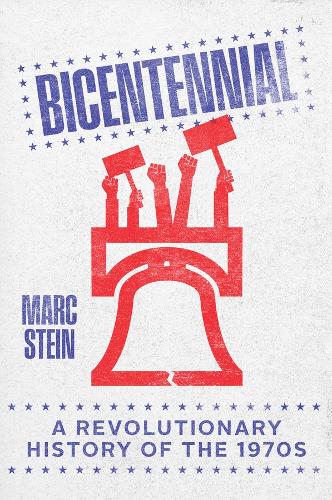
Книга Bicentennial: A Revolutionary History of the 1970s
As the United States marks its semiquincentennial in 2026, renowned historian Marc Stein looks back at the politics of another landmark celebration during a time of striking similarities and surprising differences: the US bicentennial in 1976.
In the aftermath of Vietnam and Watergate, the bicentennial sparked an extraordinary national conversation about the country’s past, present, and future. As patriots, planners, profiteers, and protesters argued about how to commemorate the national birthday, they collectively reimagined the promises and perils of democracy during a transformational decade.
From award-winning historian Marc Stein, Bicentennial: A Revolutionary History of the 1970s is an original, illuminating, and insightful study of that era. While focusing on festivities and fights in Philadelphia, the nation’s birthplace, the book also explores the many proposed and abandoned celebrations that percolated up around the country. It tells a broadly democratic story of both the “official” bicentennial and counter-bicentennial activism, offering revolutionary perspectives on national politics, social movements, and popular culture. From the queer courtship of President Richard Nixon and Philadelphia Mayor Frank Rizzo to parades and protests with millions of participants, and from a deadly outbreak of Legionnaires’ disease at Philadelphia’s most prestigious hotel to the establishment of groundbreaking African American, ethnic, and Jewish museums, the bicentennial reveals a kaleidoscope of American peculiarities, problems, and possibilities.
The lasting influence of 1976 on one of the nation’s great urban centers and the United States as a whole is undeniable. As the nation—once again enmeshed in political and social upheaval—marks its two-hundred-fiftieth birthday in 2026, there is no better time to look back at its two-hundredth and marvel at what has changed, and what has not.
"
“What do Americans want and need from the anniversary? And are historians able—or willing—to give it to them? . . . Who owns the American Revolution, and how to chronicle it, has been contested almost since it ended. . . . Stein, a professor at San Francisco State University and the author of a new book about the 1976 Bicentennial, noted that the anniversary had inspired many grass-roots ‘counter-bicentennials’ emphasizing Black, Indigenous, L.G.B.T.Q. and other perspectives. Those efforts powerfully changed popular understandings of the Revolution. But the broadening of history—including who gets to write it—has also posed a challenge for the profession.”
" - The New York Times"
“As the nation prepares to mark the two-hundred-and-fiftieth anniversary of its founding, it’s easy to forget that the two hundredth wasn’t exactly smooth sailing. . . . The simmering resentments of the Bicentennial reached their fullest expression, unsurprisingly, in Philadelphia, as the historian Stein recounts in Bicentennial: A Revolutionary History of the 1970s.”
" - The New Yorker"
"As historian Stein traces in Bicentennial: A Revolutionary History of the 1970s, a national birthday can launch a much broader, more inclusive, and ambitious national project. . . . Stein’s framing of historical commemoration as an opportunity for change invites Americans to show up to the national birthday party with visions of the nation they want. Bicentennial dares readers to believe that American independence is worth commemorating, in the face of countless existential threats to the country and to the world. Our presence matters—to help shape the country for the next fifty years. But it’s a precarious work: If nations lasted forever, we probably would not mark their birthdays."
" - The New Republic"
"I highly recommend . . . Stein’s Bicentennial: A Revolutionary History of the 1970s, which explores the two-hundredth anniversary of the signing of the Declaration. The book looks closely specifically at how the city of Philadelphia worked toward its important moment in the public spotlight on July 4, 1976, and the fallout. It’s a fascinating look at how Republican president Richard Nixon and Democratic mayor Frank Rizzo attempted to work toward bringing the two-hundredth to Philly. Politics was never absent from this story and [Bicentennial] serves as a reminder that the debates that divide Americans today were every bit as present fifty years ago."
" - Civil War Memory"
“The United States marks its semiquincentennial in 2026, and Stein looks back at the differences and similarities to the US Bicentennial in 1976. . . . Stein shows that, outside the official planning and programming, the values and rhetoric of the Revolutionary era sparked a spirit of ’76 that pushed for LGBTQIA+ rights, women’s equality, and justice reforms unimaginable two centuries earlier. It also exposed a grimmer history, as white supremacists and anti-immigration activists surfaced to claim the celebration. A comprehensive and critical look at the Spirit of 1976.”
" - Library Journal