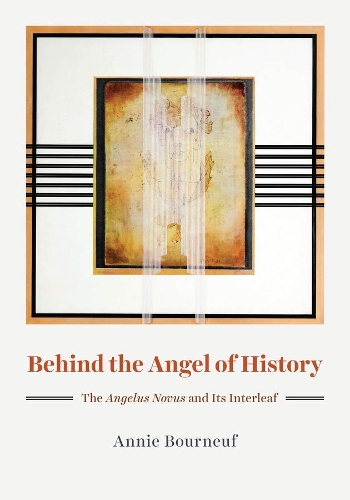
Книга Behind the Angel of History: The "Angelus Novus" and Its Interleaf
The story of artist R. H. Quaytman’s discovery of an engraving hidden behind a famous artwork by Paul Klee.
This book begins with artist R. H. Quaytman uncovering something startling about a picture by Paul Klee. Pasted beneath Klee’s 1920 Angelus Novus—famous for its role in the writings of its first owner, Walter Benjamin—Quaytman found that Klee had interleaved a nineteenth-century engraving of Martin Luther, leaving just enough visible to provoke questions.
Behind the Angel of History reveals why this hidden face matters, delving into the intertwined artistic, political, and theological issues consuming Germany in the wake of the Great War. With the Angelus Novus, Klee responded to a growing call for a new religious art. For Benjamin, Klee’s Angelus became bound up with the prospect of meaningful dialogue among religions in Germany.
Reflecting on Klee’s, Benjamin’s, and Quaytman’s strategies of superimposing conflicting images, Annie Bourneuf reveals new dimensions of complexity in this iconic work and the writing it inspired.
"Bourneuf’s magisterial, amazingly lucid commentary discusses Matthias Grünewald, whose Isenheim Altarpiece in Colmar, France, contains a figure resembling this angel. She also addresses debates between Benjamin and Scholem about Martin Buber’s philosophy, and the larger implications of Benjamin’s and Scholem’s questions about Jewish cultural identity." - Hyperallergic
"Behind the Angel of History weaves a fascinating, multi-strand tapestry, a web of associations, filiations, and unexpected connections. The richness of the 'backstories' that Bourneuf sees intertwined through a sheet of black paper is nothing short of astonishing, and the glimpses into Klee’s and Benjamin’s worlds transform that hidden black sheet into an unexpected portal. The presentation’s deliberately non-linear structure is the book’s major strength . . . It is a wild ride." - Commonweal
"In her new book Behind the Angel of History: The 'Angelus Novus' and Its Interleaf, Bourneuf addresses the complicated questions of interpretation arising from this revelation. Bourneuf’s work brings us face-to-face with this mysterious, mute angel, in unexpected ways." - New Criterion
"Bourneuf’s remarkable study will interest students of modernist art, German intellectual history, and broader audiences interested in how a single artwork can be transformed by material framing, fastening, precedents, parodies, and philosophical recastings. No discussion of Klee’s artwork or the ninth thesis can avoid engaging its arguments. Even those who see the original will know that what lies behind the 'Angelus Novus' keeps it from being fully exposed." - Critical Inquiry