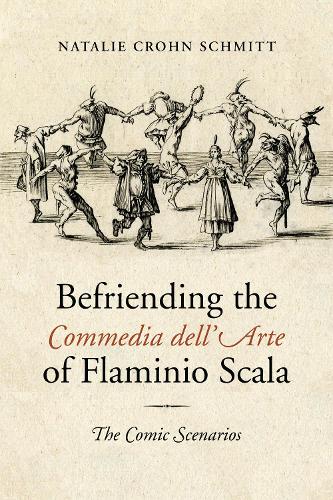
Книга Befriending the Commedia dell'Arte of Flaminio Scala: The Comic Scenarios
"Natalie Schmitt's research in Befriending the Commedia dell'Arte of Flaminio Scala offers a genuinely new take on important material. The readership for this book should extend beyond Italian studies scholars and those interested in Renaissance studies to include scholars of theatre history and early modern performance." -- Maria Galli Stampino, Department of Modern Languages and Literatures, University of Miami
The most important theatrical movement in sixteenth- and early seventeenth-century Europe, the commedia dell’arte has inspired playwrights, artists, and musicians including Molière, Dario Fo, Picasso, and Stravinsky. Because of its stock characters, improvised dialogue, and extravagant theatricalism, the commedia dell’arte is often assumed to be a superficial comic style. With Befriending the Commedia dell’Arte of Flaminio Scala, Natalie Crohn Schmitt demolishes that assumption.
By reconstructing the commedia dell’arte scenarios published by troupe manager Flaminio Scala (1547–1624), Schmitt demonstrates that in its Golden Age the commedia dell’arte relied as much on craftsmanship as on improvisation and that Scala’s scenarios are a treasure trove of social commentary on early modern daily life in Italy.
In the book, Schmitt makes use of her intensive research into the social and cultural history of sixteenth-century Italy and the aesthetic principles of the period. She combines this research with her insights drawn from studying with contemporary commedia dell’arte performers and from directing a production of one of Scala’s scenarios. The result is a new perspective on the commedia dell’arte that illuminates the style’s full richness.
"
‘Schmitt’s project challenges the next generation of scholars to see beyond the arbitrary division of textual or cultural history in order to mine the rich material provided in the hundreds of extant commedia scenarios yet to be fully explored.’
" - Comparative Drama vol 49:02:2015"
‘Schmitt leaves us with a rich dramaturgical document to foster our respect for Scala’s commedia dell’arte… Her deep appreciation of Scala shines through.’
" - Renaissance Quarterly vol 68:04:2014"
‘Like Seneca’s bees, Professor Schmitt has collected nectar from different species of flowers and skillfully blended it into a most digestible form of honey… This book is a delight to read.’
" - Sixteenth Century Studies vol 47:02:2016"
‘I recommend the sound methodology, as well as the rich dramaturgical information, that this book provides to anyone considering bringing one of Scala's Commedia dell'arte scenarios to life.’
" - Theatre Journal, vol 67:4:2015"
The commedia dell'arte was one of the most important theatrical movements in early modern Europe… The genre is widely viewed as superficial. Natalie Crohn Schmitt debunks this perception, using the work of Flaminio Scala to illustrate the commedia dell'arte's rich craftsmanship and social commentary.
" - University of Chicago Magazine, Nov-Dec 2014"
‘Professor Schmitt's beautiful and incisively detailed book goes a long way to celebrate their [Scala's scenarios] inspirational genius.’
" - Theatre Research International, 41:2:2016"
‘This book offers a fresh perspective on not only the four specific scenarios of focus, but on the opus of Flaminio Scala and, by extension, on the commedia dell'arte. It is an asset to any scholar of Italian studies, Renaissance studies, theatre, performance, the commedia dell'arte, and many other areas of research and interest.’
" - Quaderni d'italianistica 36: 01:2015"
‘Schmitt’s approach to Scala’s scenarios is eminently sensible in its practicality and highly impressive for its pedagogical potential…. Excellent study.’
" - Theatre Survey vol 58:01:2017