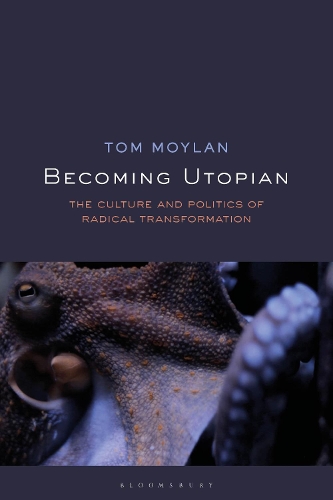
Книга Becoming Utopian: The Culture and Politics of Radical Transformation
One of the pioneers of contemporary utopian studies explores the relationship between the utopian imagination, human identity and political agency in 21st century theory and science fiction.
A dream of a better world is a powerful human force that inspires activists, artists, and citizens alike. In this book Tom Moylan – one of the pioneering scholars of contemporary utopian studies – explores the utopian process in its individual and collective trajectory from dream to realization. Drawing on theorists such as Fredric Jameson, Donna Haraway and Alain Badiou and science fiction writers such as Kim Stanley Robinson and China Miéville, Becoming Utopian develops its argument for sociopolitical action through studies that range from liberation theology, ecological activism, and radical pedagogy to the radical movements of 1968. Throughout, Moylan speaks to the urgent need to confront and transform the global environmental, economic, political and cultural crises of our time.
"This is the kind of book that utopian studies needs." - Pedagogy, Culture & Society
"Becoming Utopian is an invaluable explication of utopian thought and its link to sf since the 1960s. The book also provides a model for how producing knowledge in these fields is a pedagogically enriching as well as intellectually satisfying engagement with the world in which we live." - Science Fiction Studies
"Tom Moylan has been one of the reference authors in the formation of an international academic field of utopian studies … concerned with the transformation of the current world. … Hence, the importance of this book in which he has included nine of his works representative of the contributions with which he has stimulated and enriched the intellectual debate throughout the last 15 years." - Historia y Política (Bloomsbury Translation)
"Becoming Utopian is a synthesis of engagements and concerns and a completion of hermeneutic and political wagers, a vital addition to socially conscious and politically engaged scholarship, and a contribution that may prove as lasting as Moylan’s two major works that preceded it. It is mature, engaged, and urgent at once, just as it is both profoundly self-reflexive and passionately attuned to the difference inherent in utopian rupture. It is an always already classical work, for it is a work of authentic humanist sensibility that is poised to inspire and nurture scholarship for years to come." - Dr. Antonis Balasopoulos, University of Cyprus