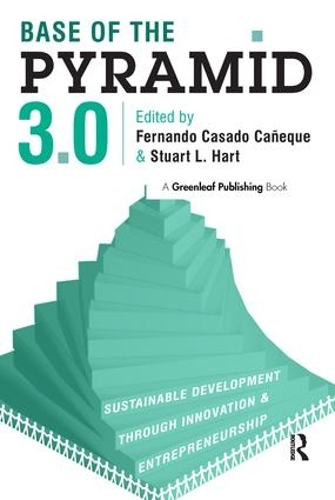
Книга Base of the Pyramid 3.0: Sustainable Development through Innovation and Entrepreneurship
Base of the Pyramid 3.0 is a must-read for anyone that wants to understand the evolution, challenges and opportunities of BoP. For many companies, creating value from the half of the world's population who live on less than $8 a day is unimaginable. This book provides insight into how companies with purpose and ambition can be profitable by creating sustainable livelihoods with sustainable natural capital. -- John Gardner, Chief Sustainability Officer, Novelis Inc In this landmark book, Stuart Hart and Fernando Casado Caneque assemble a roadmap for businesses that seek greater purpose. All businesses, not only those in low-income markets, will benefit from its practical insights into what it takes to run a company that is inclusive, culturally embedded, environmentally sensitive and profitable. Base of the Pyramid 3.0 reflects the evolution of business itself. As Peter F. Drucker wrote in his 1994 HBR article titled "The Theory of Business", every company has to make assumptions about its broader environment (society, customers, values, and behaviors) in ways that reflect its unique historical era. In the past such assumptions were centered on making money by serving the material needs of consumers at any cost to society and the environment. Later they evolved to embrace sustainability and corporate responsibility efforts that do less harm. Today the cause celebre of business is having a net positive impact on society. Businesses have become our last best hope of finding solutions to intractable challenges such as, among other global problems, creating prosperity for the four billion people who live on less than $8 per day. If the Base of the Pyramid 1.0 was about selling to the poor and version 2.0 was about co-creating markets with the poor, then version 3.0 is about transforming the entire socio-economic system in which the poor find themselves. It is aimed at creating profoundly positive effects on their whole communities rather than just new business models or products that are green or socially responsible. It emphasizes the urgent need for scalable solutions rather than piecemeal pilot projects. The authors draw on the considerable but mixed track record of BoP innovations since Stuart Hart and C.K. Prahalad's original article in 2002. In-depth case studies of failure, such as CleanStar Mozambique, are used to draw lessons from what has not worked and to propose new rules of the road. This is not just another feel-good book about the business opportunity to create a better world. It offers a collective voice of experience with specific, actionable ideas for an inclusive business agenda. A much-needed book that will be required reading in all my business courses. -- Dr Chris Laszlo, Weatherhead School of Management at Case Western Reserve University and the Drucker School of Management at Claremont Graduate University This insightful book recognizes the importance of continuing to push our thinking about the BoP domain. Fernando Casado Caneque, Stuart Hart and their colleagues offer valuable contributions on a range of topics crucial to enhancing our understanding of how to build successful BoP businesses. -- Ted London, Senior Research Fellow and Director, Base of the Pyramid Initiative, University of Michigan's Ross School of Business Stuart Hart and Fernando Casado Caneque are carrying the BoP torch forward, collaborating with many colleagues and followers, gathering greater momentum, noting further refinement of thought, and encouraging greater engagements of the communities that are being served. Base of the Pyramid 3.0 particularly emphasizes the transition to engagement and participation through partnerships, ecosystems, and networks. -- Iqbal Z. Quadir, Professor of the Practice of Development and Entrepreneurship, MIT In addition to providing high value inspiration and a demonstration of what can be achieved for all those who are, or should be, involved in global poverty alleviation, the book by Fernando Casado Caneque, Stuart Hart and their colleagues is a must-read for all those who are involved in creating a new generation of business and public leaders for a better world. The book shows us again that important, sometimes major, innovations and entrepreneurial breakthroughs come from the periphery (as the BoP unfortunately and unjustly is still considered to be) rather than from the mainstream. For business schools that are themselves still on the periphery of the global search for the new role of business in society, sustainable development and responsible leadership, this is a challenge, but also a great opportunity. They should themselves be more innovative and entrepreneurial. Integrating the lessons from this insightful book into a management education approach and philosophy could be a way to go. -- Milenko Gudic, PRME Anti-poverty Working Group Coordinator Praise for Stuart Hart: Stuart Hart was there at the beginning. Years ago when the term 'sustainability' had not yet reached the business schools, Stuart Hart stood as a beacon glowing in the umbrage. It is clear commerce is the engine of change, design the first signal of human intention, and global capitalism is at the crossroads. -- William McDonough, University of Virginia, co-author of 'Cradle to Cradle'
For well over 4 billion people – approximately 60% of all humanity – annual income is less than $1,500. The term "Base of the Pyramid" was first coined by Stuart L. Hart and C.K. Prahalad in 2002 and has become synonymous with both the method by which we can more effectively address poverty and the opportunity that exists in a multi-trillion-dollar market. A whole new lexicon has emerged to describe this phenomenon, including new buzzwords and catch phrases like "inclusive business", "opportunities for the majority", "sustainable livelihoods", "pro-poor business" and “social business”, and thousands of new businesses, institutions and investment funds have been set up.In this ground-breaking new book, Stuart L. Hart and Fernando Casado Cañeque have worked with members of the BoP Global Network to shake the tree, look objectively at what has happened since 2002, highlight why earlier applications of BoP haven’t worked and propose new objectives and ways of working to formulate more sustainable solutions.
The book challenges the reader and organizations to think about the mindset and purpose across whole organizations, open innovation rather than simply co-creation, and a complete review of the innovation ecosystem.
Through this book, practitioners will gain a clearer insight into which business models can work within different communities to ensure a sustainable transition to improved local economies. Equally, the book is a must-read for researchers and students in the fields of entrepreneurship, innovation, sustainable development and environmental management.