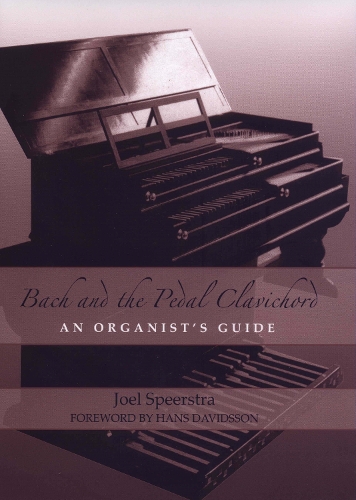
Книга Bach and the Pedal Clavichord: An Organist's Guide
An examination of the role of the pedal clavichord in understanding the work of J. S. Bach, as well as its relevance to contemporary organ performances. Friederich Griepenkerl, in his 1844 introduction to Volume 1 of the first complete edition of J. S. Bach's organ works, wrote: "Actually the six Sonatas and the Passacaglia were written for a clavichord with two manuals and pedal,an instrument that, in those days, every beginning organist possessed, which they used beforehand, to practice playing with hands and feet in order to make effective use of them at the organ. It would be a good thing to let suchinstruments be made again, because actually no one who wants to study to be an organist can really do without one." What was the role of the pedal clavichord in music history? Was it a cheap practice instrument for organistsor was Griepenkerl right? Was it a teaching tool that helped contribute to the quality of organ playing in its golden age? Most twentieth-century commentary on the pedal clavichord as an historical phenomenon was written in a kindof vacuum, since there were no playable historical models with which to experiment and from which to make an informed judgment. At the heart of Bach and the Pedal Clavichord: An Organist's Guide are some extraordinary recentexperiments from the Göteborg Organ Art Center [GOArt] at Göteborg University. The Johan David Gerstenberg pedal clavichord from 1766, now in the Leipzig University museum, was documented and reconstructed; the new copy was thenused for several years as a living instrument for organ students and teachers to experience. On the basis of these experiments and experiences, the book explores, in new and artful ways, Bach's keyboard technique, a technique preserved by his first biographer, J. N. Forkel [1802], and by Forkel's own student, Griepenkerl.
"This is an extremely important study which brings together valuable musicological research and practical experimentation in a unique way -- every organist should read it!" - CHOIR & ORGAN, September 2004
"Synthesizing a wealth of historical documentation along with the results of new, experimental studies, Speerstra [Eastman School of Music] has written a thorough analysis of the musicological and performance issues that surround the ambigious history and usage of the pedal clavichord. Despite its subtitle, this book should prove valuable for a broad audience not limited to organists; it speaks to all keyboardists interested in expanding their interpretation of Baroque literature. Highly recommended." - CHOICE
"Joel Speerstra's work presents a fascinating paradigm for the study of J.S. Bach's organ music that leads performance practice research in a new direction . . . [Speerstra] lays a path for a living performance practice that promotes an integral relationship between the organ and the pedal clavichord." - NOTES, March 2005
"There is much of brilliance in this book." - EARLY MUSIC, January 2005
"Joel Speerstra's book is a wide-ranging study of the pedal clavichord's role in the interpretation of Bach's organ music. Whether one accepts the author's premise or not, organists and clavichordists without access to such a rare instrument may discover new insights into baroque performance practice that can be applied to more readily available instruments. EIGHTEENTH-CENTURY MUSIC, 2005 [Stewart Pollens] Original and brilliant study . . . Anyone interested in keyboard instruments of any kind will find in it a great fund of information and insight into matters of general musical interest, especially the performance of Bach's music." - EARLY MUSIC TODAY