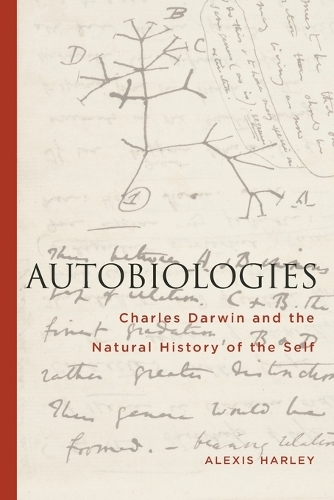
Книга Autobiologies: Charles Darwin and the Natural History of the Self
What does heredity mean for identity? What role does the individual have in shaping a personal or a human history? What is the ethical status of seemingly biologically determined behaviours? What does individual death mean in the light of species extinction? Autobiologies explores the importance of such questions in Victorian life writing. Analysing memoirs, diaries, letters, and natural histories Alexis Harley demonstrates how theories of natural selection shaped nineteenth-century autobiographical practices and refashioned the human subject—and also how the lived experience of the individual theorist simultaneously impacted their biological formulations.
"Harley suggests that the 'Victorian preoccupation with self' was a force in driving the development of evolutionary ideas, indicating that Charles Darwin’s evolutionary scheme resulted from his concept of self; i.e., 'life around him shaped his theory.' The author finds a relation between the work of the biologist and the autobiographer because both biologists and autobiographers are obsessed with observation and documenting life, thus reinforcing the idea that there is a strong connection between biology and biography. . . .[The author] explains that such Victorian evolutionists as Darwin took up autobiography (or autobiology) by examining the effects of evolutionary theories on the self. . . .The book is primarily for those concerned with literary subjects. Summing Up: Recommended. Graduate students and researchers/faculty." - CHOICE
"Overall, Harley’s book offers a well-researched and accessible glimpse into the often contradictory convergence of Victorian life-writing and evolutionary science. It is also a timely addition, given both the recent critical interest in nineteenth-century life-writing and the push for more interdisciplinary academic research. . . this text remains, on the whole, a convincing study, which significantly enlarges our understanding of Darwin’s staggering impact upon the Victorian age." - Australasian Journal of Victorian Studies
"Harley suggests that the 'Victorian preoccupation with self' was a force in driving the development of evolutionary ideas, indicating that Charles Darwin’s evolutionary scheme resulted from his concept of self; i.e., 'life around him shaped his theory.' The author finds a relation between the work of the biologist and the autobiographer because both biologists and autobiographers are obsessed with observation and documenting life, thus reinforcing the idea that there is a strong connection between biology and biography. . . .[The author] explains that such Victorian evolutionists as Darwin took up autobiography (or autobiology) by examining the effects of evolutionary theories on the self. . . .The book is primarily for those concerned with literary subjects. Summing Up: Recommended. Graduate students and researchers/faculty." - CHOICE