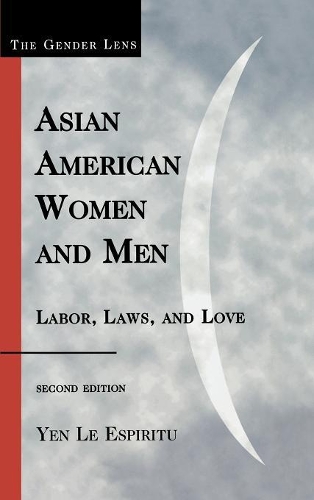
Книга Asian American Women and Men: Labor, Laws, and Love
Labor, laws, and love. Yen Le Espiritu explores how racist and gendered labor conditions and immigration laws have affected relations between and among Asian American women and men. Asian American Men and Women documents how the historical and contemporary oppression of Asians in the United States has (re)structured the balance of power between Asian American women and men and shaped their struggles to create and maintain social institutions and systems of meaning. Espiritu emphasizes how race, gender, and class, as categories of difference, do not parallel but instead intersect and confirm one other.
"Espiritu examines the historical and contemporary experiences of Asian American women and men—with each other and with the dominant white society—from a gendered perspective. Locating gender in its intersection with race and class, this is one of the few works in ethnic studies or women's/gender studies that actually discusses the matrix of race/gender/class structures of oppression within a specific racial-ethnic community, i.e., Asian Americans, one that is also largely an immigrant community. Espiritu lends support to charges by women of color that traditional feminist theory falsely universalizes the category of 'women,' and overlooks the positions that white men and white women occupy over men of color. She also admits that this work does not disrupt the 'male-centered' framework of Asian American studies. The historical oppression of Asian Americans is explored along material and cultural lines, e.g., the formal and informal labor markets, including prostitution; family and small businesses; Japanese American internment; marriage and family; refugee resettlement; racist stereotyping. Theoretically, Espiritu advances the concept of 'racialized patriarchy.' She concludes with a call to create an 'imagined community' of cross-gender, cross-cultural," - CHOICE
"Espiritu examines the historical and contemporary experiences of Asian American women and men—with each other and with the dominant white society—from a gendered perspective. Locating gender in its intersection with race and class, this is one of the few works in ethnic studies or women's/gender studies that actually discusses the matrix of race/gender/class structures of oppression within a specific racial-ethnic community, i.e., Asian Americans, one that is also largely an immigrant community. Espiritu lends support to charges by women of color that traditional feminist theory falsely universalizes the category of 'women,' and overlooks the positions that white men and white women occupy over men of color. She also admits that this work does not disrupt the 'male-centered' framework of Asian American studies. The historical oppression of Asian Americans is explored along material and cultural lines, e.g., the formal and informal labor markets, including prostitution; family and small businesses; Japanese American internment; marriage and family; refugee resettlement; racist stereotyping. Theoretically, Espiritu advances the concept of 'racialized patriarchy.' She concludes with a call to create an 'imagined community' of cross-gender, cross-cultural, and cross-class coalitions bound together by the common struggle against all pervasive forms of structured domination." - CHOICE