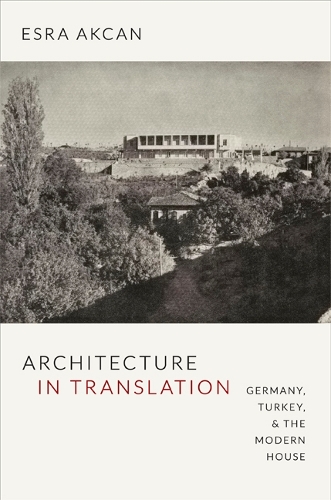
Книга Architecture in Translation: Germany, Turkey, and the Modern House
Shows how the concept of translation allows for consideration of the socio-political context and agency of all parties in cultural exchanges
In Architecture in Translation, Esra Akcan offers a way to understand the global circulation of culture that extends the notion of translation beyond language to visual fields. She shows how members of the ruling Kemalist elite in Turkey further aligned themselves with Europe by choosing German-speaking architects to oversee much of the design of modern cities. Focusing on the period from the 1920s through the 1950s, Akcan traces the geographical circulation of modern residential models, including the garden city—which emphasized green spaces separating low-density neighborhoods of houses surrounded by gardens—and mass housing built first for the working-class residents in industrial cities and, later, more broadly for mixed-income residents. She shows how the concept of translation—the process of change that occurs with transportation of people, ideas, technology, information, and images from one or more countries to another—allows for consideration of the sociopolitical context and agency of all parties in cultural exchanges. Moving beyond the indistinct concepts of hybrid and transculturation and avoiding passive metaphors such as import, influence, or transfer, translation offers a new approach relevant to many disciplines. Akcan advocates a commitment to a new culture of translatability from below for a truly cosmopolitan ethics in a globalizing world.
"“While Architecture in Translation constitutes clearly a ‘next step’ in scholarly works that examine the histories of the Turkish nation’s architectural and planning projects, it is also an ideal ‘first step’ toward analyzing more critically the dynamics of interaction and exchange that we today otherwise generalize under terms like modernization, globalization, or development. Charting the origins, diffusions, and transformations of ideas, approaches, and key actors through multiple historical and geographic contexts, Akcan’s book also emerges as a most readable and thoughtful history of ideas.” " - Comparative Studies of South Asia, Africa and the Middle East
"“Esra Akcan’s excellent book, Architecture in Translation, focuses on the history of German-Turkish exchanges in residential architecture in the 20th century...Directing her attention towards questions of urbanity, population, and housing, Akcan successfully situates architecture within the modernization paradigms of the new Turkish republic.”" - Middle East Media and Book Reviews
"“Akcan’s book is a significant contribution to the historiography of modern architecture by transcending ‘East-West’ polarization. This is a monumental undertaking and an excellent introduction to the brave new world of multipolar histories where the old fictions of a centerand a periphery no longer apply.”" - Journal of the Society of Architectural Historians
"“The readers of this book will find a history of modernism that goes beyond an imperial cartography, and will encounter multiple voices of modernism including those of patrons, clients, and inhabitants of modern architecture. In this cartography, the map that Akcan draws is a rich historical study of houses in Germany and Turkey.”" - Journal of Architectural Education
"An important contribution to cultural theory and architectural history, Architecture in Translation is specifically recommended for those interested in cultural translations in the history of the Middle East. Given the richness of its literary and visual references as well as its fluent writing style, it is an intellectual joy to read." - International Journal of Middle East Studies